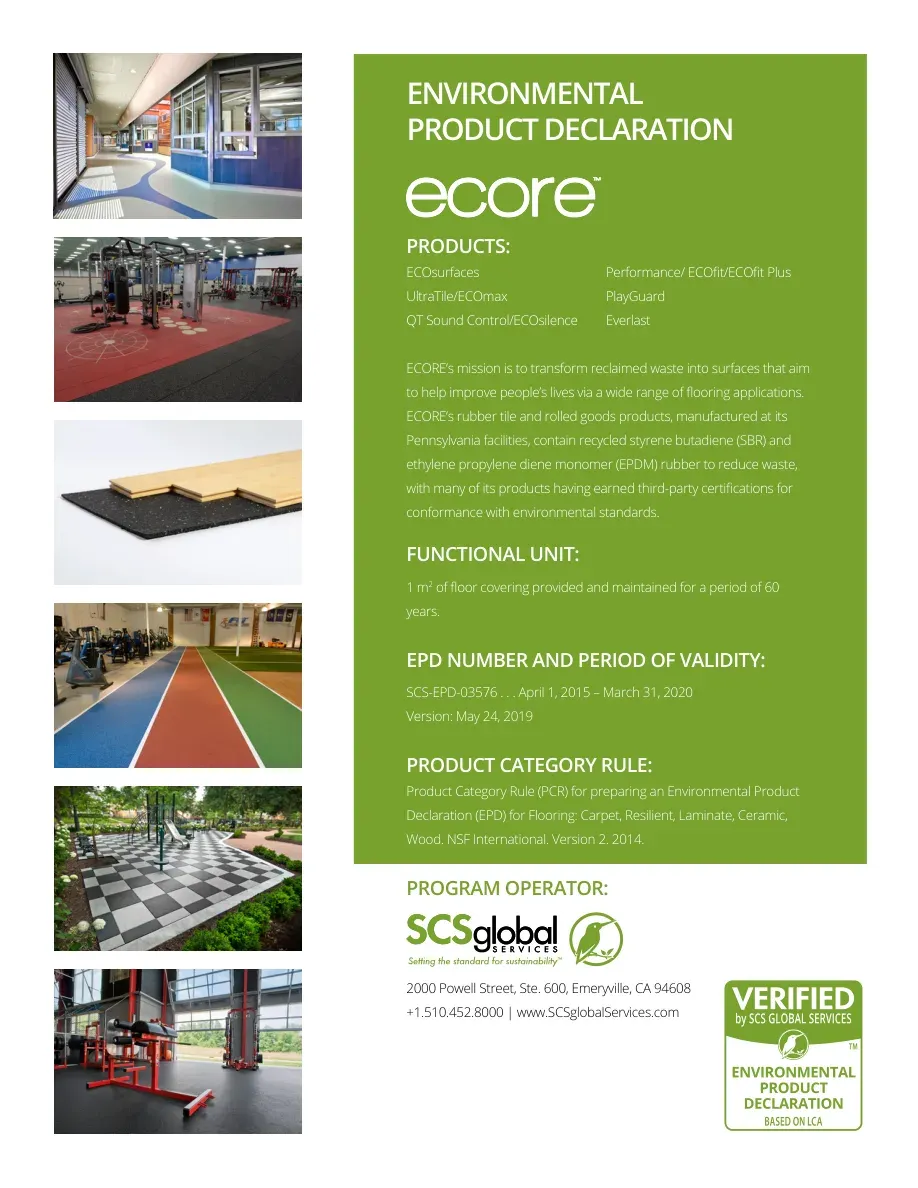
PRODUCTS: ECOsurfaces Performance/ ECOfit/ECOfit Plus UltraTile/ECOmax PlayGuard QT Sound Control/ECOsilence Everlast ECORE’s mission is to transform reclaimed waste into surfaces that aim to help improve people’s lives via a wide range of flooring applications. ECORE’s rubber tile and rolled goods products, manufactured at its Pennsylvania facilities, contain recycled styrene butadiene (SBR) and ethylene propylene diene monomer (EPDM) rubber to reduce waste, with many of its products having earned third-party certifications for conformance with environmental standards. FUNCTIONAL UNIT:1 m2 of floor covering provided and maintained for a period of 60 years. EPD NUMBER AND PERIOD OF VALIDITY: SCS-EPD-03576 . . . April 1, 2015 – March 31, 2020 Version: May 24, 2019PRODUCT CATEGORY RULE:Product Category Rule (PCR) for preparing an Environmental Product Declaration (EPD) for Flooring: Carpet, Resilient, Laminate, Ceramic, Wood. NSF International. Version 2. 2014. PROGRAM OPERATOR:2000 Powell Street, Ste. 600, Emeryville, CA 94608 +1.510.452.8000 | www.SCSglobalServices.comENVIRONMENTAL PRODUCT DECLARATION
2 Environmental Product Declaration ECORE InternationalDisclaimers: This EPD conforms to ISO 14025, 14040, and ISO 14044. Scope of Results Reported: The PCR requirements limit the scope of the LCA metrics such that the results exclude environmental and social performance benchmarks and thresholds, and exclude impacts from the depletion of natural resources, land use ecological impacts, ocean impacts related to greenhouse gas emissions, risks from hazardous wastes and impacts linked to hazardous chemical emissions. Accuracy of Results: Due to PCR constraints, this EPD provides estimations of potential impacts that are inherently limited in terms of accuracy and may include error factors up to a million-fold. Comparability: The PCR this EPD was based on was not written to support comparative assertions. EPDs based on different PCRs, or different calculation models, may not be comparable. When attempting to compare EPDs or life cycle impacts of products from different companies, the user should be aware of the uncertainty in the final results, due to and not limited to, the practitioner’s assumptions, the source of the data used in the study, and the specifics of the product modeled.PCR review, was conducted byJack Geibig, EcoFormApproved April 1, 2015. Valid until March 31, 2020.Independent verification of the declaration and data, according to ISO 14025:2006 and ISO 21930:2007. internal externalThird party verifierTable of ContentsProduct and Company Information . . . . . . . . . . . . . . . . . . . . . . . . . . . . . . . . . . . . . . . . . . . . . . . . . . . . . . . . . . . . . . . . . . . coverProduct Description . . . . . . . . . . . . . . . . . . . . . . . . . . . . . . . . . . . . . . . . . . . . . . . . . . . . . . . . . . . . . . . . . . . . . . . . . . . . . . . . . . . . 3Product Performance. . . . . . . . . . . . . . . . . . . . . . . . . . . . . . . . . . . . . . . . . . . . . . . . . . . . . . . . . . . . . . . . . . . . . . . . . . . . . . . . . . . 5Product Applications. . . . . . . . . . . . . . . . . . . . . . . . . . . . . . . . . . . . . . . . . . . . . . . . . . . . . . . . . . . . . . . . . . . . . . . . . . . . . . . . . . . . 8Material Content . . . . . . . . . . . . . . . . . . . . . . . . . . . . . . . . . . . . . . . . . . . . . . . . . . . . . . . . . . . . . . . . . . . . . . . . . . . . . . . . . . . . . . . 8Production of Main Materials. . . . . . . . . . . . . . . . . . . . . . . . . . . . . . . . . . . . . . . . . . . . . . . . . . . . . . . . . . . . . . . . . . . . . . . . . . . .10Product Characteristics. . . . . . . . . . . . . . . . . . . . . . . . . . . . . . . . . . . . . . . . . . . . . . . . . . . . . . . . . . . . . . . . . . . . . . . . . . . . . . . . . 11Additional Environmental Information. . . . . . . . . . . . . . . . . . . . . . . . . . . . . . . . . . . . . . . . . . . . . . . . . . . . . . . . . . . . . . . . . . . . 13Life Cycle Assessment. . . . . . . . . . . . . . . . . . . . . . . . . . . . . . . . . . . . . . . . . . . . . . . . . . . . . . . . . . . . . . . . . . . . . . . . . . . . . . . . . . 13Product Life Cycle Flow Diagram. . . . . . . . . . . . . . . . . . . . . . . . . . . . . . . . . . . . . . . . . . . . . . . . . . . . . . . . . . . . . . . . . . . . . . . . . 14Life Cycle Assessment Stages and Reported EPD Information. . . . . . . . . . . . . . . . . . . . . . . . . . . . . . . . . . . . . . . . . . . . . . . 17Life Cycle Impact Inventory . . . . . . . . . . . . . . . . . . . . . . . . . . . . . . . . . . . . . . . . . . . . . . . . . . . . . . . . . . . . . . . . . . . . . . . . . . . . . 19Life Cycle Impact Assessment. . . . . . . . . . . . . . . . . . . . . . . . . . . . . . . . . . . . . . . . . . . . . . . . . . . . . . . . . . . . . . . . . . . . . . . . . . . 20Supporting Technical Information . . . . . . . . . . . . . . . . . . . . . . . . . . . . . . . . . . . . . . . . . . . . . . . . . . . . . . . . . . . . . . . . . . . . . . . 29References . . . . . . . . . . . . . . . . . . . . . . . . . . . . . . . . . . . . . . . . . . . . . . . . . . . . . . . . . . . . . . . . . . . . . . . . . . . . . . . . . . . . . . . . . . . 32Fjalar Kommonen, FFK Ltd.
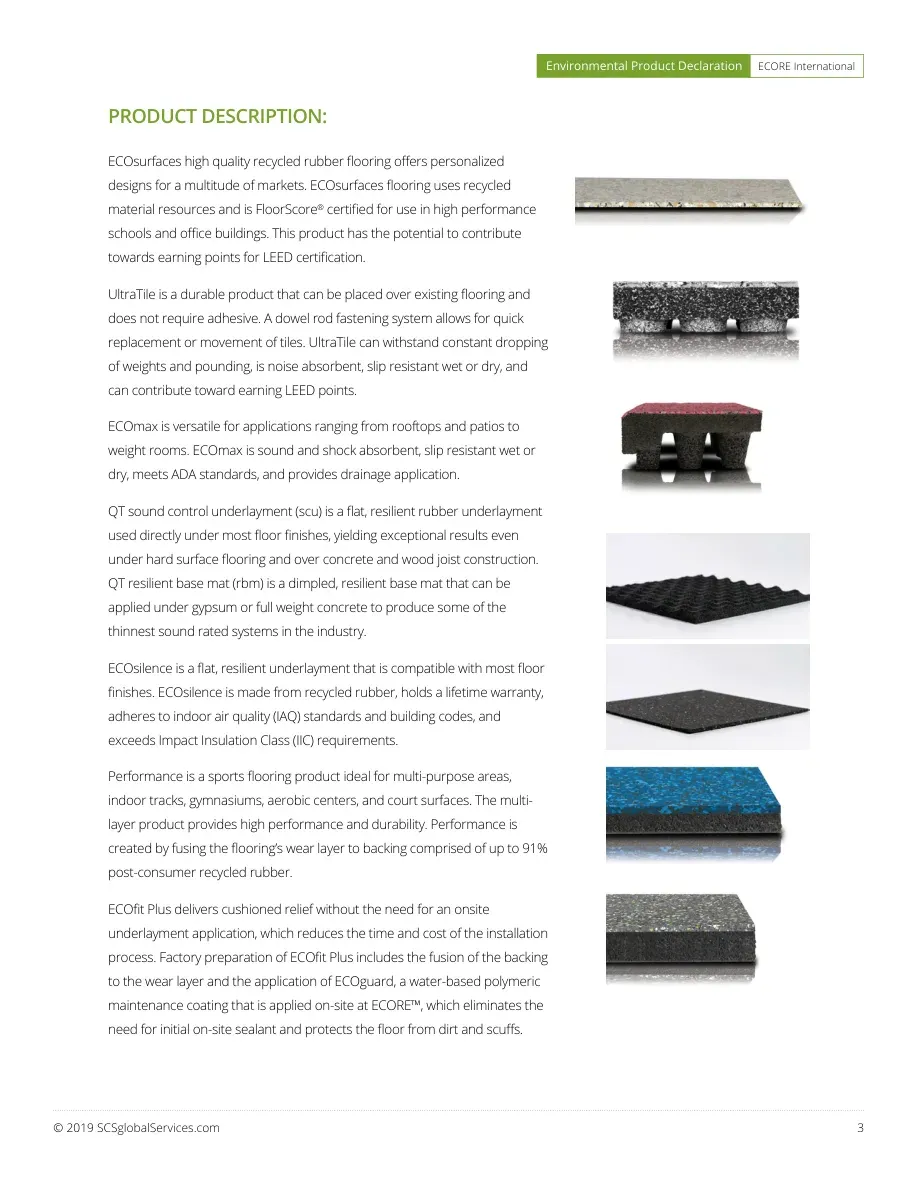
© 2019 SCSglobalServices.com 3 Environmental Product Declaration ECORE InternationalPRODUCT DESCRIPTION:ECOsurfaces high quality recycled rubber flooring offers personalized designs for a multitude of markets. ECOsurfaces flooring uses recycled material resources and is FloorScore® certified for use in high performance schools and office buildings. This product has the potential to contribute towards earning points for LEED certification. UltraTile is a durable product that can be placed over existing flooring and does not require adhesive. A dowel rod fastening system allows for quick replacement or movement of tiles. UltraTile can withstand constant dropping of weights and pounding, is noise absorbent, slip resistant wet or dry, and can contribute toward earning LEED points.ECOmax is versatile for applications ranging from rooftops and patios to weight rooms. ECOmax is sound and shock absorbent, slip resistant wet or dry, meets ADA standards, and provides drainage application.QT sound control underlayment (scu) is a flat, resilient rubber underlayment used directly under most floor finishes, yielding exceptional results even under hard surface flooring and over concrete and wood joist construction. QT resilient base mat (rbm) is a dimpled, resilient base mat that can be applied under gypsum or full weight concrete to produce some of the thinnest sound rated systems in the industry. ECOsilence is a flat, resilient underlayment that is compatible with most floor finishes. ECOsilence is made from recycled rubber, holds a lifetime warranty, adheres to indoor air quality (IAQ) standards and building codes, and exceeds Impact Insulation Class (IIC) requirements. Performance is a sports flooring product ideal for multi-purpose areas, indoor tracks, gymnasiums, aerobic centers, and court surfaces. The multi-layer product provides high performance and durability. Performance is created by fusing the flooring’s wear layer to backing comprised of up to 91% post-consumer recycled rubber. ECOfit Plus delivers cushioned relief without the need for an onsite underlayment application, which reduces the time and cost of the installation process. Factory preparation of ECOfit Plus includes the fusion of the backing to the wear layer and the application of ECOguard, a water-based polymeric maintenance coating that is applied on-site at ECORE™, which eliminates the need for initial on-site sealant and protects the floor from dirt and scuffs.
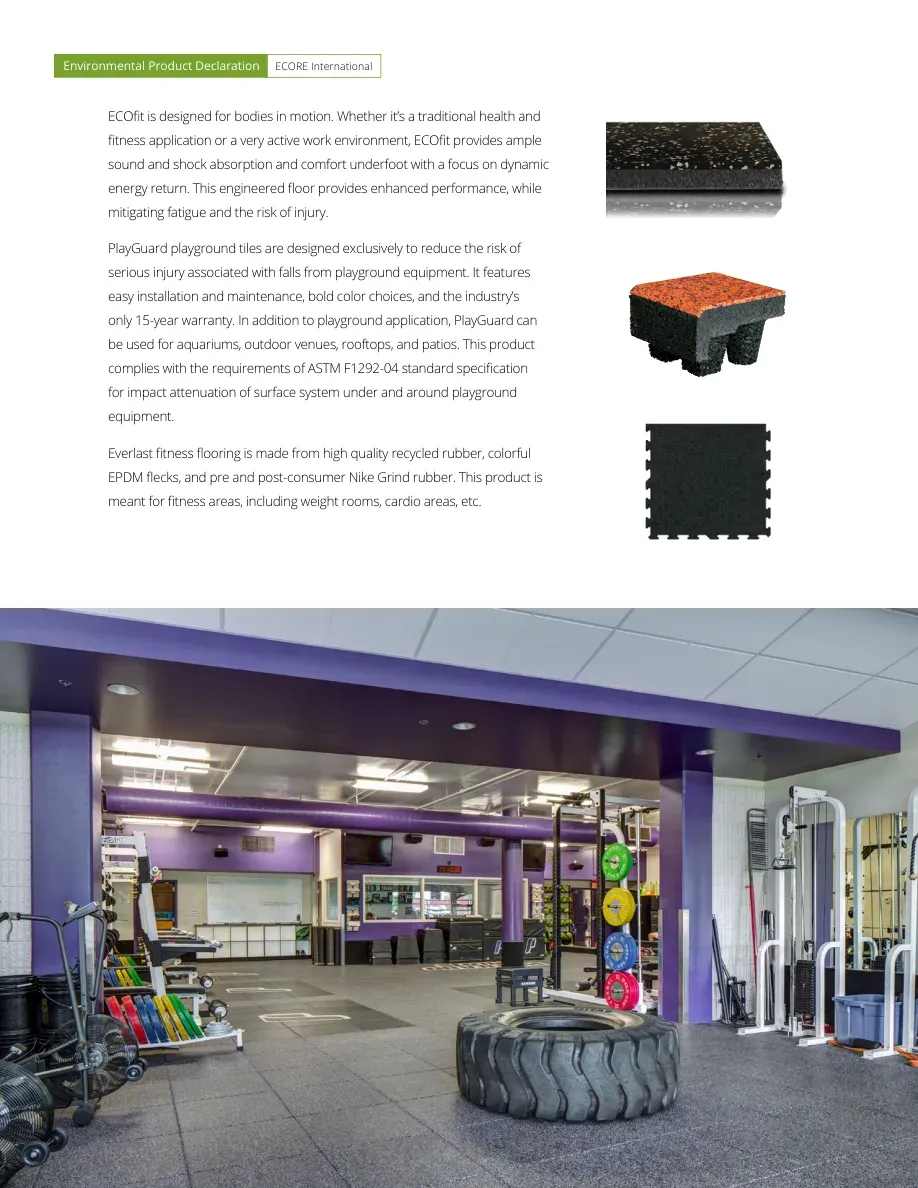
4 Environmental Product Declaration ECORE InternationalECOfit is designed for bodies in motion. Whether it’s a traditional health and fitness application or a very active work environment, ECOfit provides ample sound and shock absorption and comfort underfoot with a focus on dynamic energy return. This engineered floor provides enhanced performance, while mitigating fatigue and the risk of injury.PlayGuard playground tiles are designed exclusively to reduce the risk of serious injury associated with falls from playground equipment. It features easy installation and maintenance, bold color choices, and the industry’s only 15-year warranty. In addition to playground application, PlayGuard can be used for aquariums, outdoor venues, rooftops, and patios. This product complies with the requirements of ASTM F1292-04 standard specification for impact attenuation of surface system under and around playground equipment. Everlast fitness flooring is made from high quality recycled rubber, colorful EPDM flecks, and pre and post-consumer Nike Grind rubber. This product is meant for fitness areas, including weight rooms, cardio areas, etc.
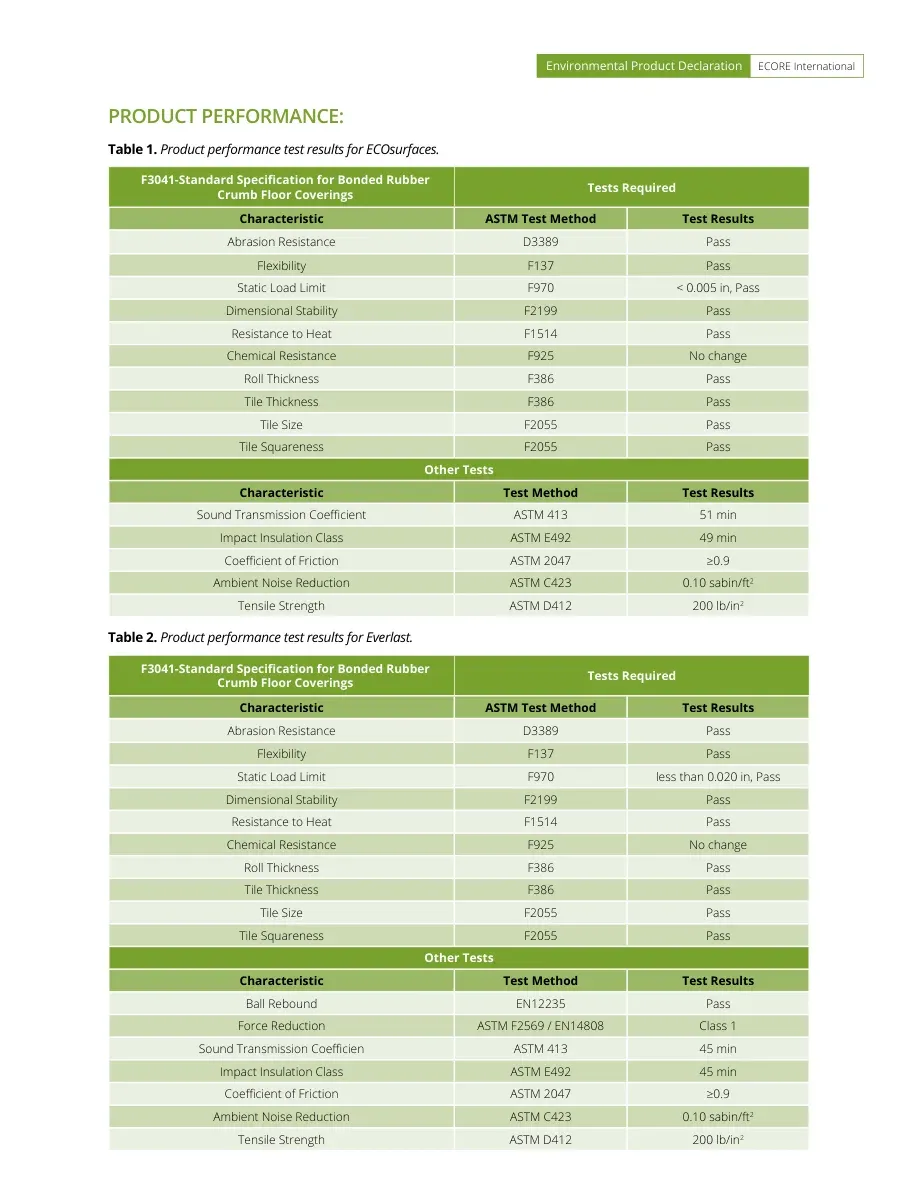
© 2019 SCSglobalServices.com 5 Environmental Product Declaration ECORE InternationalPRODUCT PERFORMANCE:Table 1. Product performance test results for ECOsurfaces.F3041-Standard Specification for Bonded Rubber Crumb Floor CoveringsTests RequiredCharacteristicASTM Test MethodTest ResultsAbrasion ResistanceD3389PassFlexibilityF137PassStatic Load LimitF970< 0.005 in, PassDimensional StabilityF2199PassResistance to HeatF1514PassChemical ResistanceF925No changeRoll ThicknessF386PassTile ThicknessF386PassTile SizeF2055PassTile SquarenessF2055PassOther TestsCharacteristicTest MethodTest ResultsSound Transmission CoefficientASTM 41351 minImpact Insulation ClassASTM E49249 minCoefficient of FrictionASTM 2047≥0.9Ambient Noise ReductionASTM C4230.10 sabin/ft2Tensile StrengthASTM D412200 lb/in2Table 2. Product performance test results for Everlast.F3041-Standard Specification for Bonded Rubber Crumb Floor CoveringsTests RequiredCharacteristicASTM Test MethodTest ResultsAbrasion ResistanceD3389PassFlexibilityF137PassStatic Load LimitF970less than 0.020 in, Pass Dimensional StabilityF2199PassResistance to HeatF1514PassChemical ResistanceF925No changeRoll ThicknessF386PassTile ThicknessF386PassTile SizeF2055PassTile SquarenessF2055PassOther TestsCharacteristicTest MethodTest ResultsBall ReboundEN12235PassForce ReductionASTM F2569 / EN14808Class 1Sound Transmission CoefficienASTM 41345 minImpact Insulation ClassASTM E49245 minCoefficient of FrictionASTM 2047≥0.9Ambient Noise ReductionASTM C4230.10 sabin/ft2Tensile StrengthASTM D412200 lb/in2
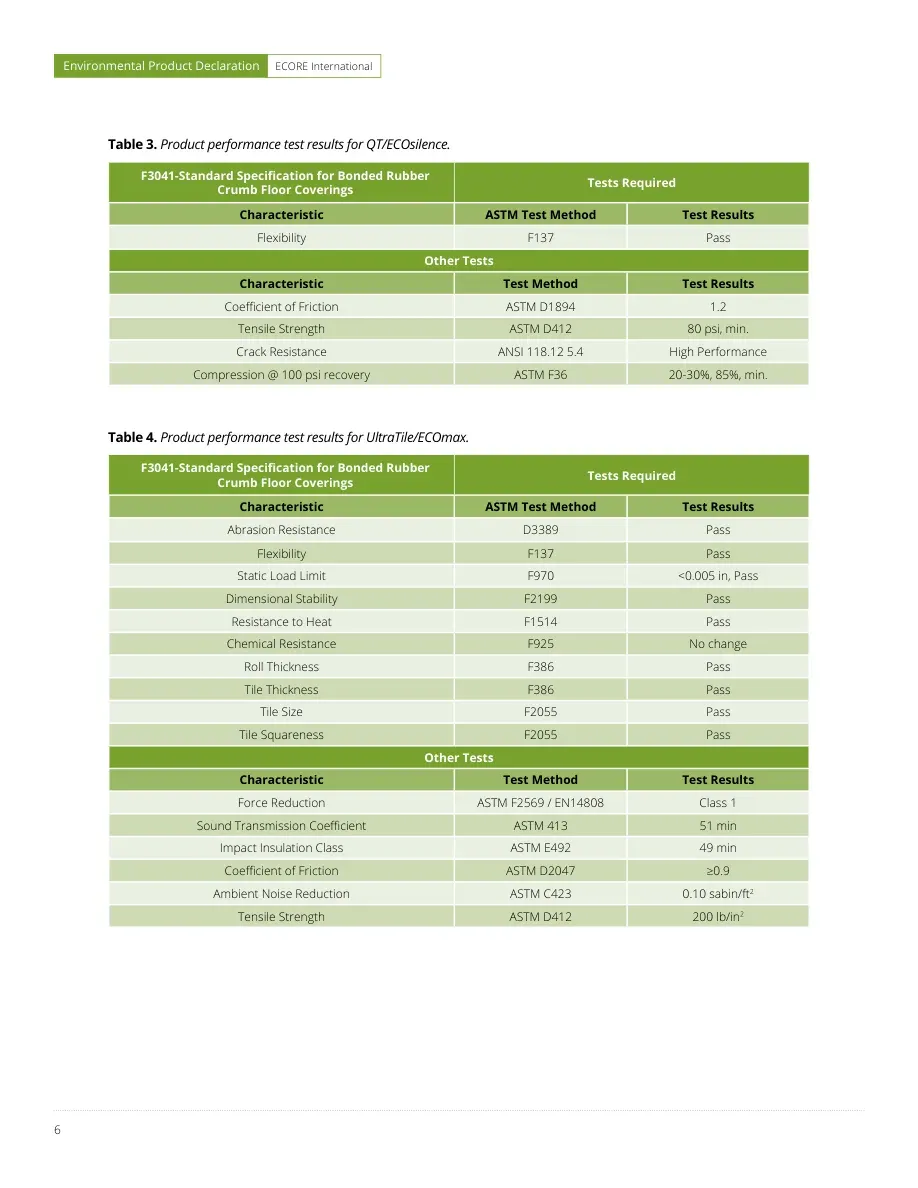
6 Environmental Product Declaration ECORE InternationalTable 3. Product performance test results for QT/ECOsilence.F3041-Standard Specification for Bonded Rubber Crumb Floor CoveringsTests RequiredCharacteristicASTM Test MethodTest ResultsFlexibilityF137PassOther TestsCharacteristicTest MethodTest ResultsCoefficient of FrictionASTM D18941.2Tensile StrengthASTM D41280 psi, min.Crack ResistanceANSI 118.12 5.4High PerformanceCompression @ 100 psi recoveryASTM F3620-30%, 85%, min.Table 4. Product performance test results for UltraTile/ECOmax.F3041-Standard Specification for Bonded Rubber Crumb Floor CoveringsTests RequiredCharacteristicASTM Test MethodTest ResultsAbrasion ResistanceD3389PassFlexibilityF137PassStatic Load LimitF970<0.005 in, Pass Dimensional StabilityF2199PassResistance to HeatF1514PassChemical ResistanceF925No changeRoll ThicknessF386PassTile ThicknessF386PassTile SizeF2055PassTile SquarenessF2055PassOther TestsCharacteristicTest MethodTest ResultsForce ReductionASTM F2569 / EN14808Class 1Sound Transmission CoefficientASTM 41351 minImpact Insulation ClassASTM E49249 minCoefficient of FrictionASTM D2047≥0.9Ambient Noise ReductionASTM C4230.10 sabin/ft2Tensile StrengthASTM D412200 lb/in2
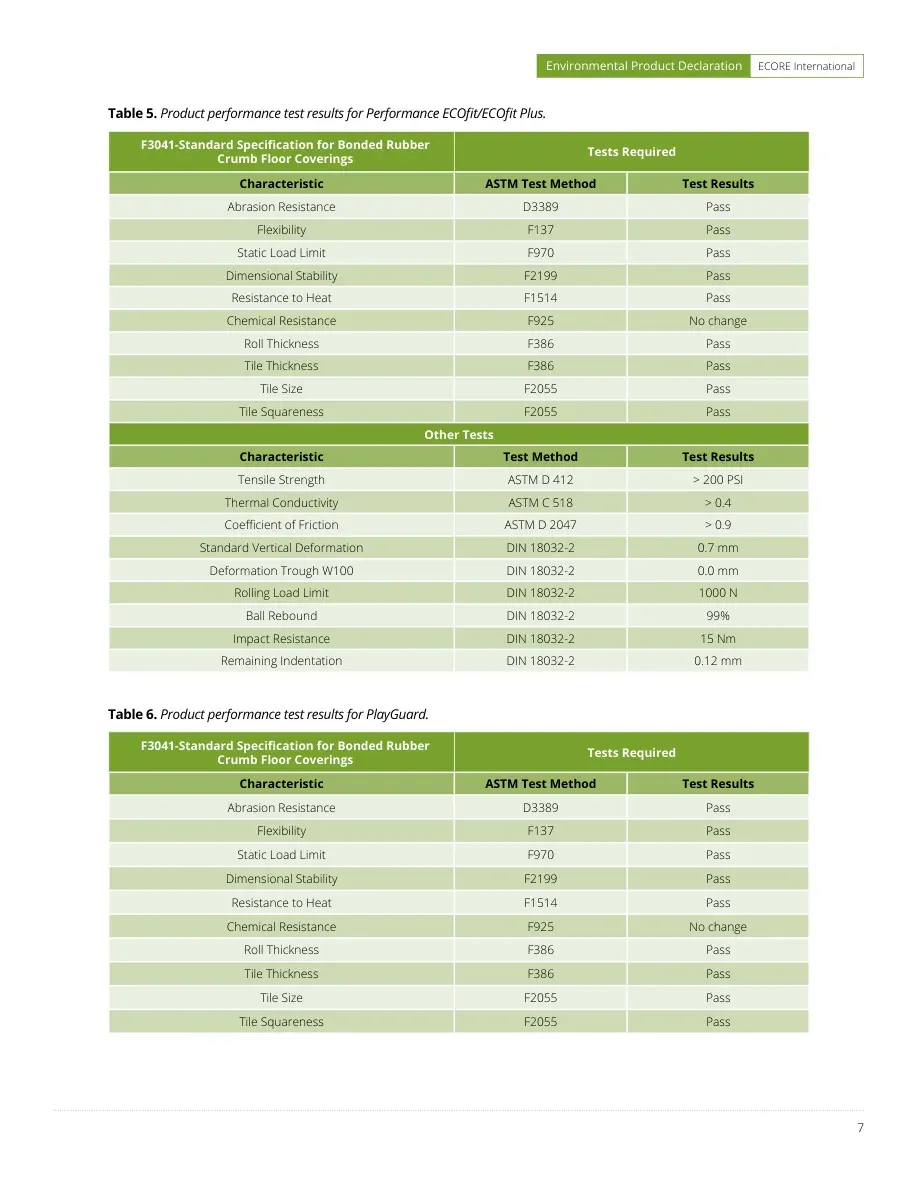
7 Environmental Product Declaration ECORE InternationalTable 5. Product performance test results for Performance ECOfit/ECOfit Plus.F3041-Standard Specification for Bonded Rubber Crumb Floor CoveringsTests RequiredCharacteristicASTM Test MethodTest ResultsAbrasion ResistanceD3389PassFlexibilityF137PassStatic Load LimitF970PassDimensional StabilityF2199PassResistance to HeatF1514PassChemical ResistanceF925No changeRoll ThicknessF386PassTile ThicknessF386PassTile SizeF2055PassTile SquarenessF2055PassOther TestsCharacteristicTest MethodTest ResultsTensile StrengthASTM D 412> 200 PSIThermal ConductivityASTM C 518> 0.4Coefficient of FrictionASTM D 2047> 0.9Standard Vertical DeformationDIN 18032-20.7 mmDeformation Trough W100DIN 18032-20.0 mmRolling Load LimitDIN 18032-21000 NBall ReboundDIN 18032-299%Impact ResistanceDIN 18032-215 NmRemaining IndentationDIN 18032-20.12 mmTable 6. Product performance test results for PlayGuard.F3041-Standard Specification for Bonded Rubber Crumb Floor CoveringsTests RequiredCharacteristicASTM Test MethodTest ResultsAbrasion ResistanceD3389PassFlexibilityF137PassStatic Load LimitF970PassDimensional StabilityF2199PassResistance to HeatF1514PassChemical ResistanceF925No changeRoll ThicknessF386PassTile ThicknessF386PassTile SizeF2055PassTile SquarenessF2055Pass
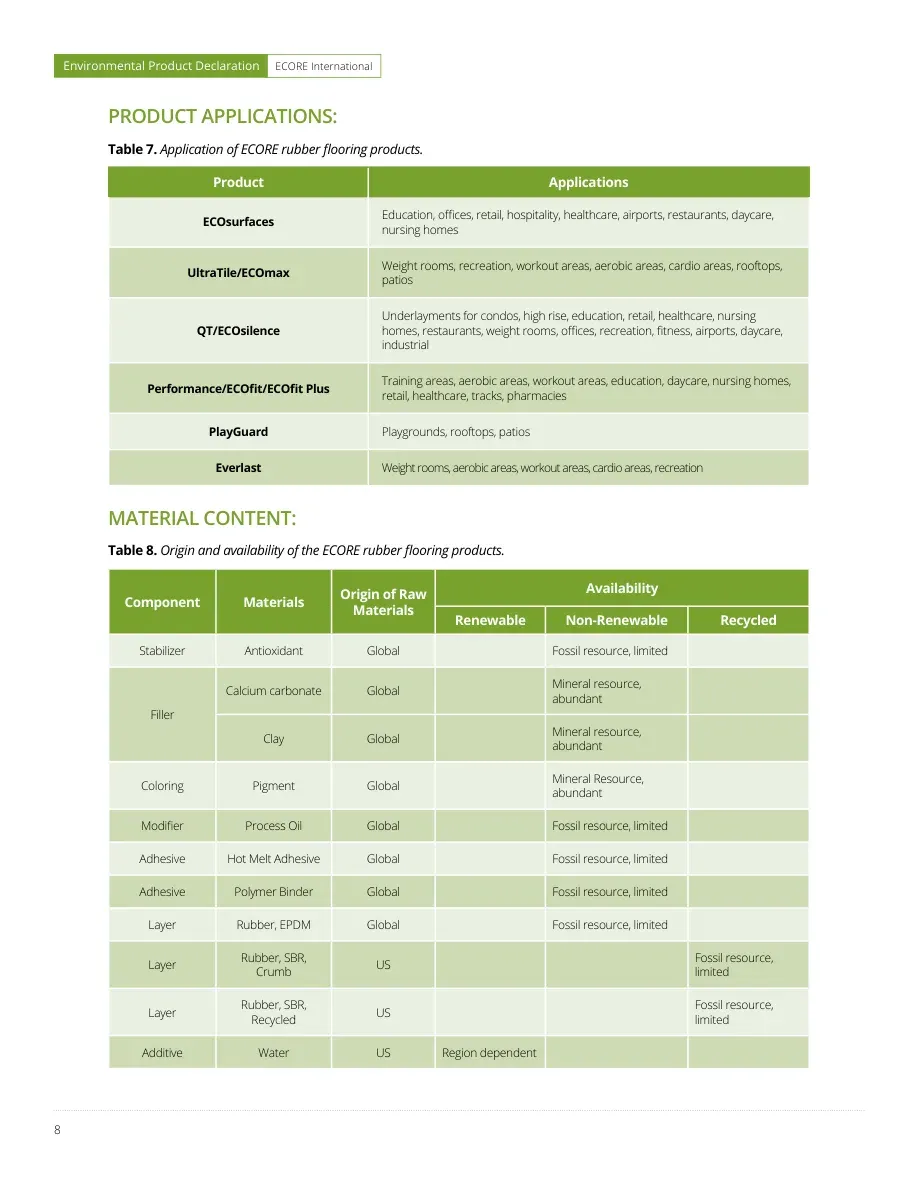
8 Environmental Product Declaration ECORE InternationalPRODUCT APPLICATIONS:Table 7. Application of ECORE rubber flooring products.ProductApplicationsECOsurfacesEducation, offices, retail, hospitality, healthcare, airports, restaurants, daycare, nursing homesUltraTile/ECOmaxWeight rooms, recreation, workout areas, aerobic areas, cardio areas, rooftops, patiosQT/ECOsilenceUnderlayments for condos, high rise, education, retail, healthcare, nursing homes, restaurants, weight rooms, offices, recreation, fitness, airports, daycare, industrialPerformance/ECOfit/ECOfit PlusTraining areas, aerobic areas, workout areas, education, daycare, nursing homes, retail, healthcare, tracks, pharmaciesPlayGuardPlaygrounds, rooftops, patiosEverlastWeight rooms, aerobic areas, workout areas, cardio areas, recreationMATERIAL CONTENT:Table 8. Origin and availability of the ECORE rubber flooring products.ComponentMaterialsOrigin of Raw MaterialsAvailabilityRenewableNon-RenewableRecycledStabilizerAntioxidantGlobalFossil resource, limitedFillerCalcium carbonateGlobalMineral resource, abundantClayGlobalMineral resource, abundantColoringPigmentGlobalMineral Resource, abundantModifierProcess OilGlobalFossil resource, limitedAdhesiveHot Melt AdhesiveGlobalFossil resource, limitedAdhesivePolymer BinderGlobalFossil resource, limitedLayerRubber, EPDMGlobalFossil resource, limitedLayerRubber, SBR, CrumbUSFossil resource, limitedLayerRubber, SBR, RecycledUSFossil resource, limitedAdditiveWaterUSRegion dependent
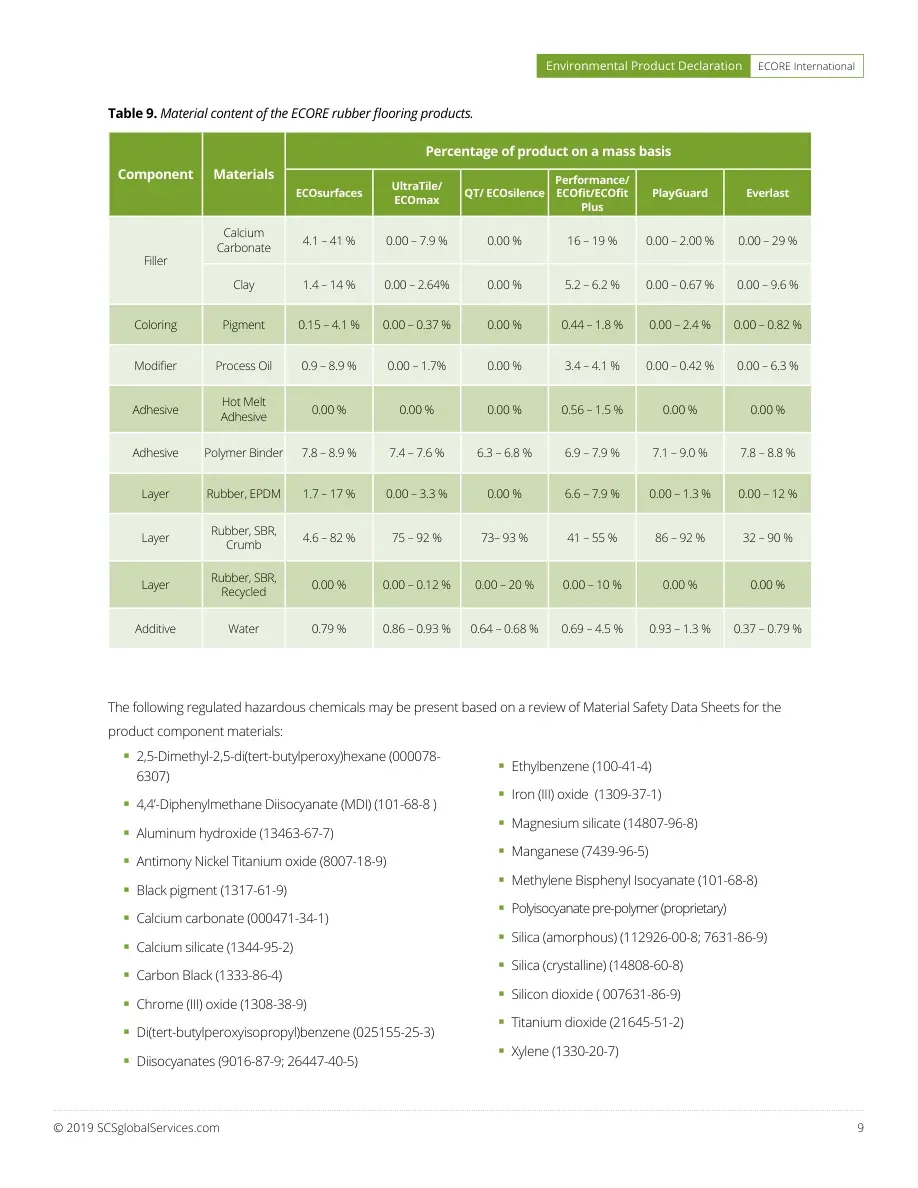
© 2019 SCSglobalServices.com 9 Environmental Product Declaration ECORE InternationalTable 9. Material content of the ECORE rubber flooring products.ComponentMaterialsPercentage of product on a mass basisECOsurfacesUltraTile/ ECOmaxQT/ ECOsilencePerformance/ ECOfit/ECOfit PlusPlayGuardEverlastFillerCalcium Carbonate4.1 – 41 %0.00 – 7.9 %0.00 %16 – 19 %0.00 – 2.00 %0.00 – 29 %Clay1.4 – 14 %0.00 – 2.64%0.00 %5.2 – 6.2 %0.00 – 0.67 %0.00 – 9.6 %ColoringPigment0.15 – 4.1 %0.00 – 0.37 %0.00 %0.44 – 1.8 %0.00 – 2.4 %0.00 – 0.82 %ModifierProcess Oil0.9 – 8.9 %0.00 – 1.7%0.00 %3.4 – 4.1 %0.00 – 0.42 %0.00 – 6.3 %AdhesiveHot Melt Adhesive0.00 %0.00 %0.00 %0.56 – 1.5 %0.00 %0.00 %AdhesivePolymer Binder7.8 – 8.9 %7.4 – 7.6 %6.3 – 6.8 %6.9 – 7.9 %7.1 – 9.0 %7.8 – 8.8 %LayerRubber, EPDM1.7 – 17 %0.00 – 3.3 %0.00 %6.6 – 7.9 %0.00 – 1.3 %0.00 – 12 %LayerRubber, SBR, Crumb4.6 – 82 %75 – 92 %73– 93 %41 – 55 %86 – 92 %32 – 90 %LayerRubber, SBR, Recycled0.00 %0.00 – 0.12 %0.00 – 20 %0.00 – 10 %0.00 %0.00 %AdditiveWater0.79 %0.86 – 0.93 %0.64 – 0.68 %0.69 – 4.5 %0.93 – 1.3 %0.37 – 0.79 %The following regulated hazardous chemicals may be present based on a review of Material Safety Data Sheets for the product component materials:§§ 2,5-Dimethyl-2,5-di(tert-butylperoxy)hexane (000078-6307)§§ 4,4’-Diphenylmethane Diisocyanate (MDI) (101-68-8 )§§ Aluminum hydroxide (13463-67-7)§§ Antimony Nickel Titanium oxide (8007-18-9)§§ Black pigment (1317-61-9)§§ Calcium carbonate (000471-34-1)§§ Calcium silicate (1344-95-2)§§ Carbon Black (1333-86-4)§§ Chrome (III) oxide (1308-38-9)§§ Di(tert-butylperoxyisopropyl)benzene (025155-25-3)§§ Diisocyanates (9016-87-9; 26447-40-5)§§ Ethylbenzene (100-41-4)§§ Iron (III) oxide (1309-37-1)§§ Magnesium silicate (14807-96-8)§§ Manganese (7439-96-5)§§ Methylene Bisphenyl Isocyanate (101-68-8)§§ Polyisocyanate pre-polymer (proprietary)§§ Silica (amorphous) (112926-00-8; 7631-86-9)§§ Silica (crystalline) (14808-60-8)§§ Silicon dioxide ( 007631-86-9)§§ Titanium dioxide (21645-51-2)§§ Xylene (1330-20-7)
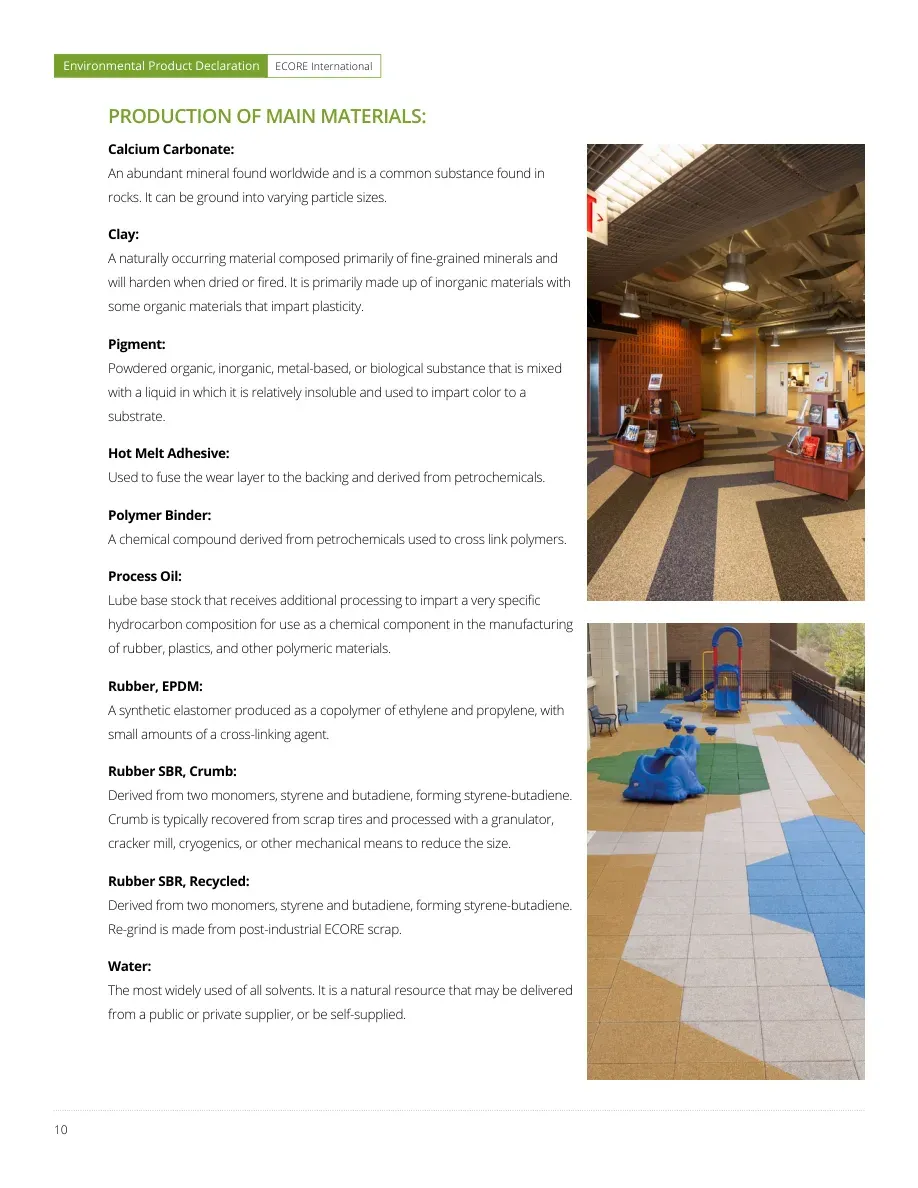
10 Environmental Product Declaration ECORE InternationalPRODUCTION OF MAIN MATERIALS:Calcium Carbonate: An abundant mineral found worldwide and is a common substance found in rocks. It can be ground into varying particle sizes. Clay: A naturally occurring material composed primarily of fine-grained minerals and will harden when dried or fired. It is primarily made up of inorganic materials with some organic materials that impart plasticity.Pigment: Powdered organic, inorganic, metal-based, or biological substance that is mixed with a liquid in which it is relatively insoluble and used to impart color to a substrate. Hot Melt Adhesive: Used to fuse the wear layer to the backing and derived from petrochemicals.Polymer Binder: A chemical compound derived from petrochemicals used to cross link polymers. Process Oil: Lube base stock that receives additional processing to impart a very specific hydrocarbon composition for use as a chemical component in the manufacturing of rubber, plastics, and other polymeric materials. Rubber, EPDM: A synthetic elastomer produced as a copolymer of ethylene and propylene, with small amounts of a cross-linking agent. Rubber SBR, Crumb: Derived from two monomers, styrene and butadiene, forming styrene-butadiene. Crumb is typically recovered from scrap tires and processed with a granulator, cracker mill, cryogenics, or other mechanical means to reduce the size. Rubber SBR, Recycled: Derived from two monomers, styrene and butadiene, forming styrene-butadiene. Re-grind is made from post-industrial ECORE scrap. Water: The most widely used of all solvents. It is a natural resource that may be delivered from a public or private supplier, or be self-supplied.
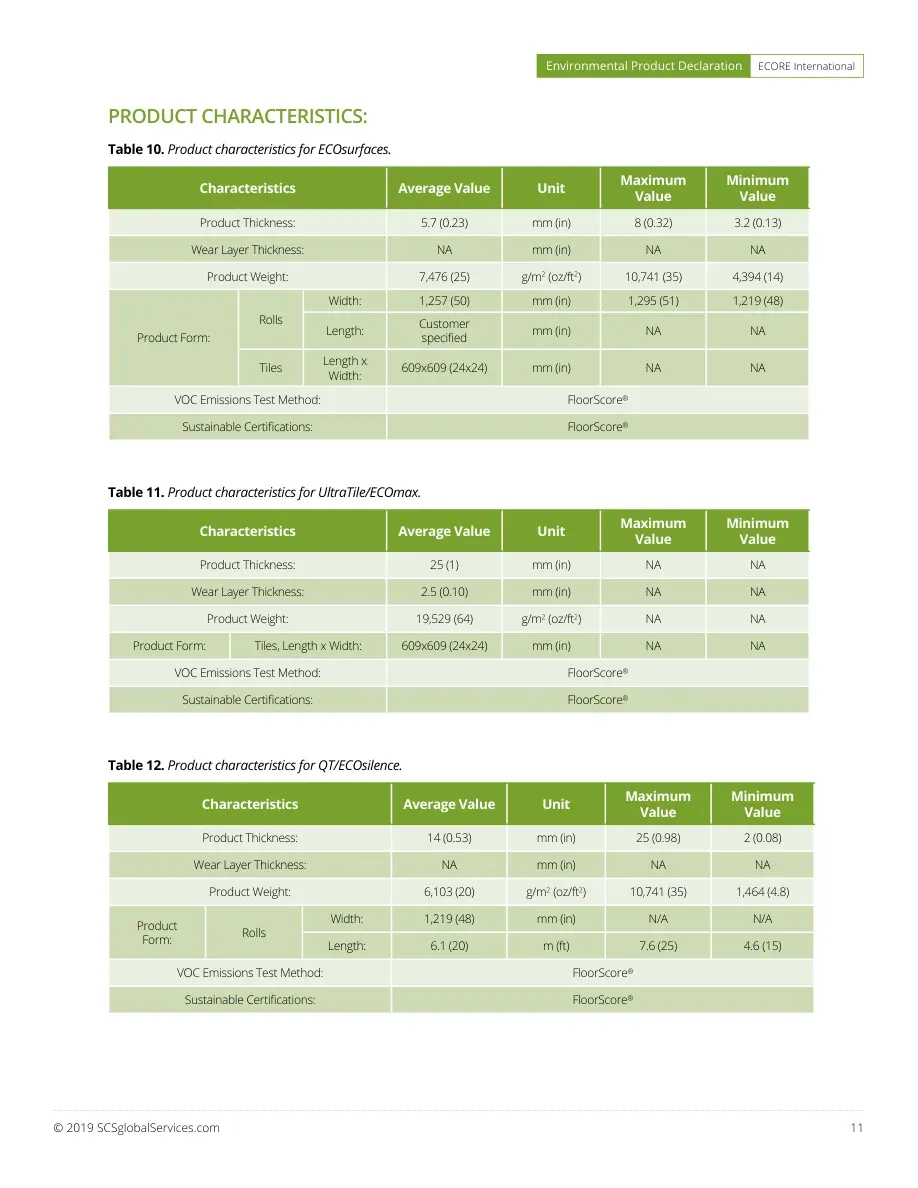
© 2019 SCSglobalServices.com 11 Environmental Product Declaration ECORE InternationalPRODUCT CHARACTERISTICS:Table 10. Product characteristics for ECOsurfaces.CharacteristicsAverage ValueUnitMaximum ValueMinimum ValueProduct Thickness:5.7 (0.23)mm (in)8 (0.32)3.2 (0.13)Wear Layer Thickness:NAmm (in)NANAProduct Weight:7,476 (25)g/m2 (oz/ft2)10,741 (35)4,394 (14)Product Form:RollsWidth:1,257 (50)mm (in)1,295 (51)1,219 (48)Length:Customer specifiedmm (in)NANATilesLength x Width:609x609 (24x24)mm (in)NANAVOC Emissions Test Method:FloorScore®Sustainable Certifications:FloorScore®Table 11. Product characteristics for UltraTile/ECOmax.CharacteristicsAverage ValueUnitMaximum ValueMinimum ValueProduct Thickness:25 (1)mm (in)NANAWear Layer Thickness:2.5 (0.10)mm (in)NANAProduct Weight:19,529 (64)g/m2 (oz/ft2)NANAProduct Form:Tiles, Length x Width:609x609 (24x24)mm (in)NANAVOC Emissions Test Method:FloorScore®Sustainable Certifications:FloorScore®Table 12. Product characteristics for QT/ECOsilence.CharacteristicsAverage ValueUnitMaximum ValueMinimum ValueProduct Thickness:14 (0.53)mm (in)25 (0.98)2 (0.08)Wear Layer Thickness:NAmm (in)NANAProduct Weight:6,103 (20)g/m2 (oz/ft2)10,741 (35)1,464 (4.8)Product Form:RollsWidth:1,219 (48)mm (in)N/AN/ALength:6.1 (20)m (ft)7.6 (25)4.6 (15)VOC Emissions Test Method:FloorScore®Sustainable Certifications:FloorScore®
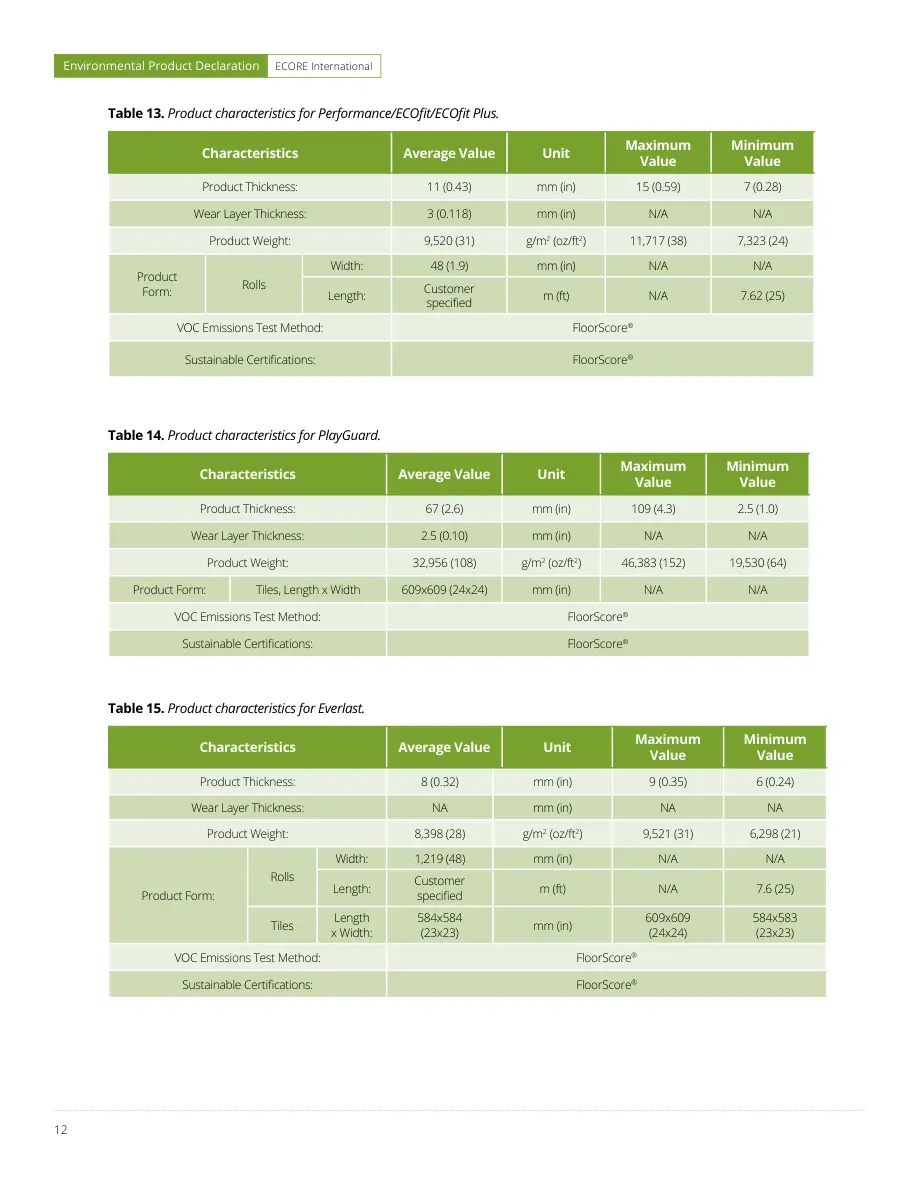
12 Environmental Product Declaration ECORE InternationalTable 13. Product characteristics for Performance/ECOfit/ECOfit Plus.CharacteristicsAverage ValueUnitMaximum ValueMinimum ValueProduct Thickness:11 (0.43)mm (in)15 (0.59)7 (0.28)Wear Layer Thickness:3 (0.118)mm (in)N/AN/AProduct Weight:9,520 (31)g/m2 (oz/ft2)11,717 (38)7,323 (24)Product Form:RollsWidth:48 (1.9)mm (in)N/AN/ALength:Customer specifiedm (ft)N/A7.62 (25)VOC Emissions Test Method:FloorScore®Sustainable Certifications:FloorScore®Table 14. Product characteristics for PlayGuard.CharacteristicsAverage ValueUnitMaximum ValueMinimum ValueProduct Thickness:67 (2.6)mm (in)109 (4.3)2.5 (1.0)Wear Layer Thickness:2.5 (0.10)mm (in)N/AN/AProduct Weight:32,956 (108)g/m2 (oz/ft2)46,383 (152)19,530 (64)Product Form:Tiles, Length x Width609x609 (24x24)mm (in)N/AN/AVOC Emissions Test Method:FloorScore®Sustainable Certifications:FloorScore®Table 15. Product characteristics for Everlast.CharacteristicsAverage ValueUnitMaximum ValueMinimum ValueProduct Thickness:8 (0.32)mm (in)9 (0.35)6 (0.24)Wear Layer Thickness:NAmm (in)NANAProduct Weight:8,398 (28) g/m2 (oz/ft2)9,521 (31)6,298 (21)Product Form:RollsWidth:1,219 (48)mm (in)N/AN/ALength:Customer specifiedm (ft)N/A7.6 (25)TilesLength x Width:584x584 (23x23)mm (in)609x609 (24x24)584x583 (23x23)VOC Emissions Test Method:FloorScore®Sustainable Certifications:FloorScore®
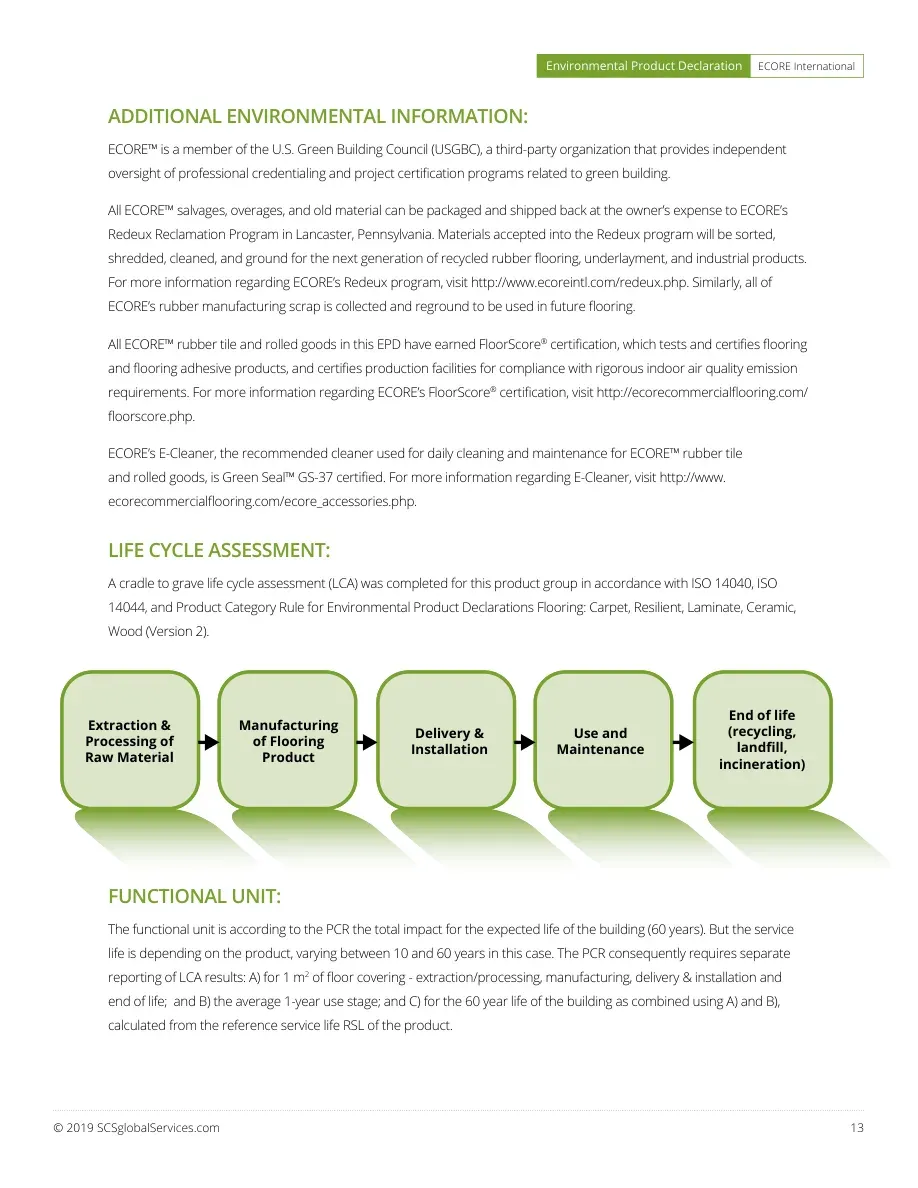
© 2019 SCSglobalServices.com 13 Environmental Product Declaration ECORE InternationalADDITIONAL ENVIRONMENTAL INFORMATION:ECORE™ is a member of the U.S. Green Building Council (USGBC), a third-party organization that provides independent oversight of professional credentialing and project certification programs related to green building. All ECORE™ salvages, overages, and old material can be packaged and shipped back at the owner’s expense to ECORE’s Redeux Reclamation Program in Lancaster, Pennsylvania. Materials accepted into the Redeux program will be sorted, shredded, cleaned, and ground for the next generation of recycled rubber flooring, underlayment, and industrial products. For more information regarding ECORE’s Redeux program, visit http://www.ecoreintl.com/redeux.php. Similarly, all of ECORE’s rubber manufacturing scrap is collected and reground to be used in future flooring.All ECORE™ rubber tile and rolled goods in this EPD have earned FloorScore® certification, which tests and certifies flooring and flooring adhesive products, and certifies production facilities for compliance with rigorous indoor air quality emission requirements. For more information regarding ECORE’s FloorScore® certification, visit http://ecorecommercialflooring.com/floorscore.php. ECORE’s E-Cleaner, the recommended cleaner used for daily cleaning and maintenance for ECORE™ rubber tile and rolled goods, is Green Seal™ GS-37 certified. For more information regarding E-Cleaner, visit http://www.ecorecommercialflooring.com/ecore_accessories.php. LIFE CYCLE ASSESSMENT: A cradle to grave life cycle assessment (LCA) was completed for this product group in accordance with ISO 14040, ISO 14044, and Product Category Rule for Environmental Product Declarations Flooring: Carpet, Resilient, Laminate, Ceramic, Wood (Version 2). FUNCTIONAL UNIT: The functional unit is according to the PCR the total impact for the expected life of the building (60 years). But the service life is depending on the product, varying between 10 and 60 years in this case. The PCR consequently requires separate reporting of LCA results: A) for 1 m2 of floor covering - extraction/processing, manufacturing, delivery & installation and end of life; and B) the average 1-year use stage; and C) for the 60 year life of the building as combined using A) and B), calculated from the reference service life RSL of the product. Extraction & Processing of Raw MaterialManufacturing of Flooring ProductUse and MaintenanceDelivery & InstallationEnd of life (recycling, landfill, incineration)
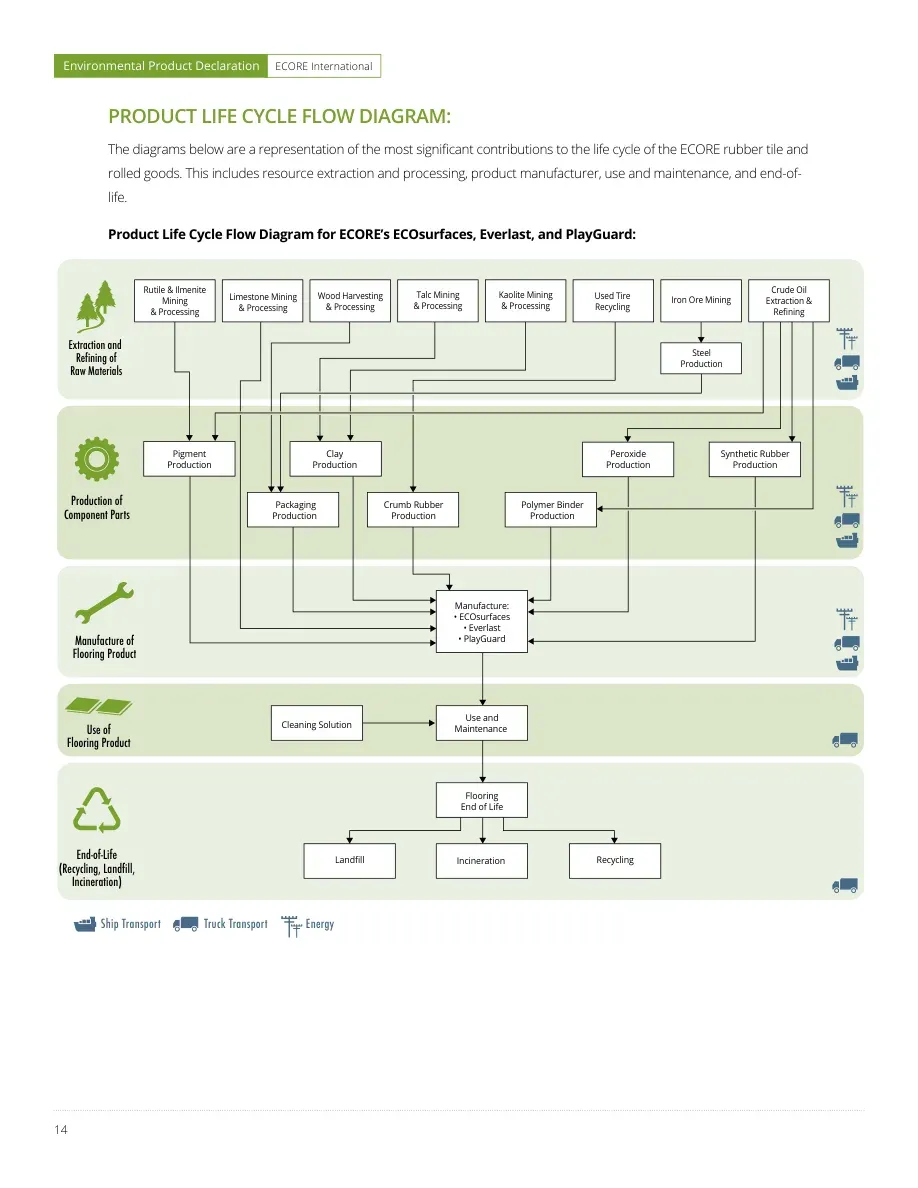
14 Environmental Product Declaration ECORE InternationalPRODUCT LIFE CYCLE FLOW DIAGRAM:The diagrams below are a representation of the most significant contributions to the life cycle of the ECORE rubber tile and rolled goods. This includes resource extraction and processing, product manufacturer, use and maintenance, and end-of-life. Product Life Cycle Flow Diagram for ECORE’s ECOsurfaces, Everlast, and PlayGuard:Extraction and Refining ofRaw MaterialsUse ofFlooring ProductShip TransportTruck TransportEnergyProduction ofComponent PartsManufacture ofFlooring ProductEnd-of-Life(Recycling, Landfill,Incineration)Manufacture:• ECOsurfaces• Everlast• PlayGuardUse andMaintenance FlooringEnd of LifeIron Ore MiningUsed Tire RecyclingKaolite Mining& ProcessingTalc Mining& ProcessingLimestone Mining& ProcessingRutile & Ilmenite Mining& ProcessingCrude OilExtraction & Refining SteelProductionLandfillRecyclingIncineration Cleaning SolutionWood Harvesting& ProcessingCrumb RubberProductionPolymer BinderProductionPackagingProduction ClayProductionPeroxideProductionSynthetic RubberProductionPigmentProduction
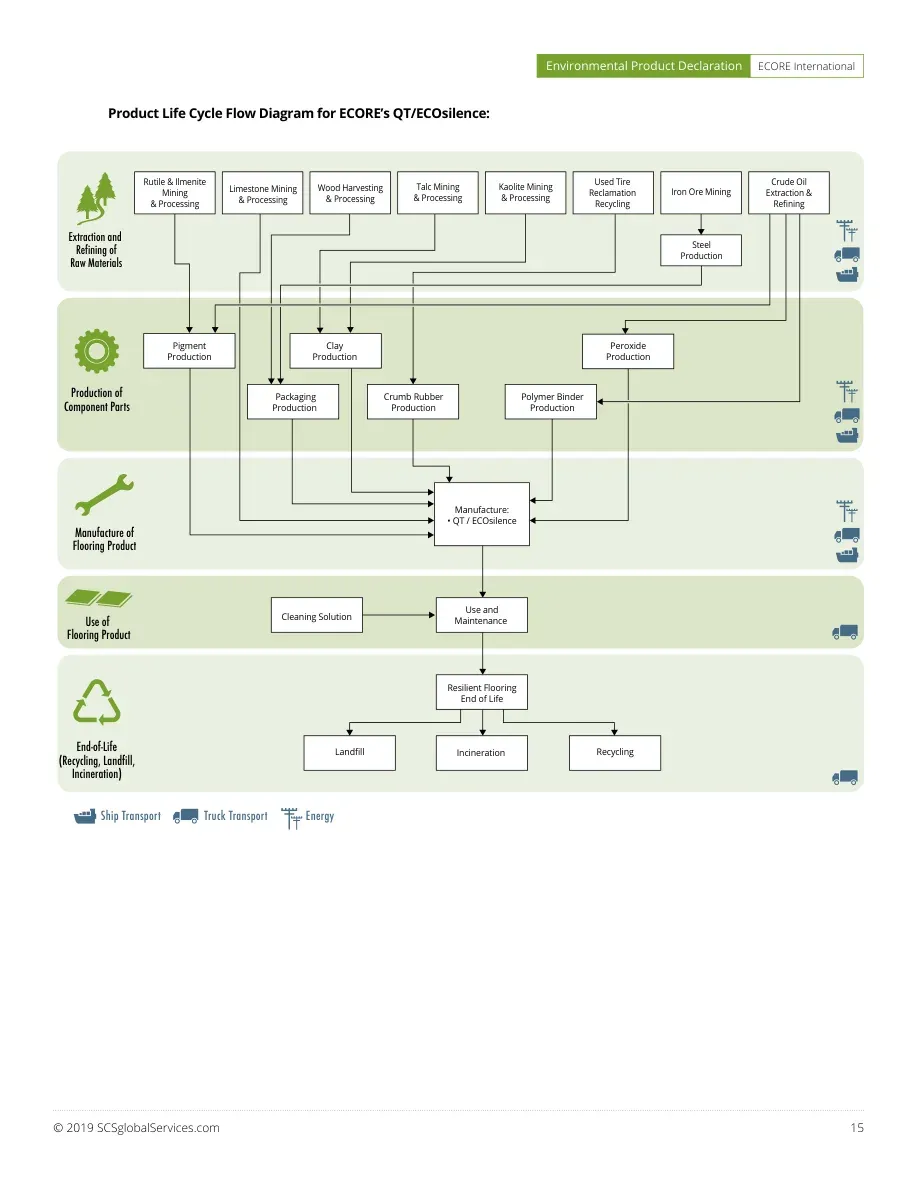
© 2019 SCSglobalServices.com 15 Environmental Product Declaration ECORE InternationalProduct Life Cycle Flow Diagram for ECORE’s QT/ECOsilence:Extraction and Refining ofRaw MaterialsUse of Flooring ProductShip TransportTruck TransportEnergyProduction ofComponent PartsManufacture ofFlooring ProductEnd-of-Life(Recycling, Landfill,Incineration)Manufacture:• QT / ECOsilenceUse andMaintenance Resilient FlooringEnd of LifeIron Ore MiningUsed Tire Reclamation RecyclingKaolite Mining& ProcessingTalc Mining& ProcessingLimestone Mining& ProcessingRutile & Ilmenite Mining& ProcessingCrude OilExtraction & Refining SteelProductionLandfillRecyclingIncineration Cleaning SolutionWood Harvesting& ProcessingCrumb RubberProductionPolymer BinderProductionPackagingProduction ClayProductionPeroxideProductionPigmentProduction
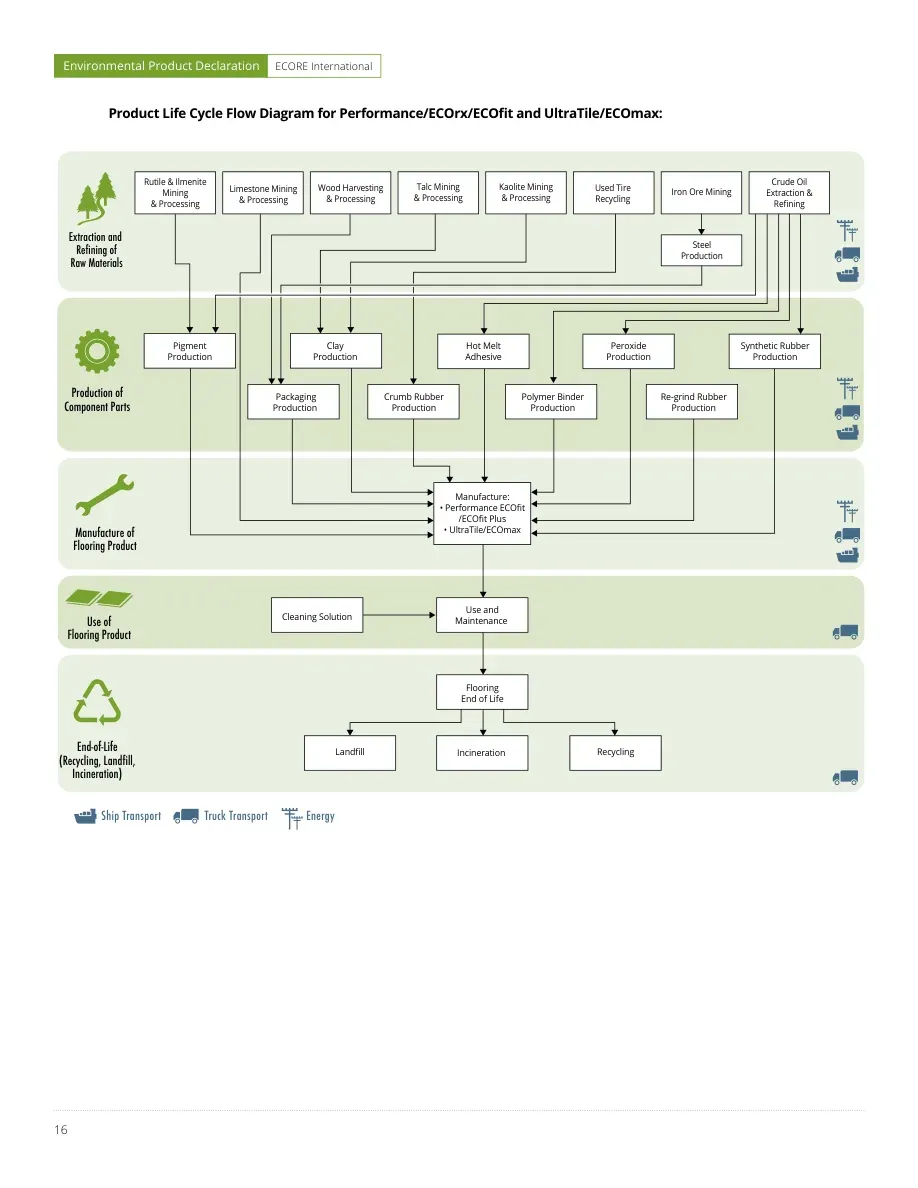
16 Environmental Product Declaration ECORE InternationalProduct Life Cycle Flow Diagram for Performance/ECOrx/ECOfit and UltraTile/ECOmax:Extraction and Refining ofRaw MaterialsUse ofFlooring ProductShip TransportTruck TransportEnergyProduction ofComponent PartsManufacture ofFlooring ProductEnd-of-Life(Recycling, Landfill,Incineration)Manufacture:• Performance ECOfit/ECOfit Plus• UltraTile/ECOmaxUse andMaintenance FlooringEnd of LifeIron Ore MiningUsed Tire RecyclingKaolite Mining& ProcessingTalc Mining& ProcessingLimestone Mining& ProcessingRutile & Ilmenite Mining& ProcessingCrude OilExtraction & Refining SteelProductionLandfillRecyclingIncineration Cleaning SolutionWood Harvesting& ProcessingCrumb RubberProductionPolymer BinderProductionPackagingProduction ClayProductionHot MeltAdhesivePeroxideProductionSynthetic RubberProductionPigmentProductionRe-grind RubberProduction
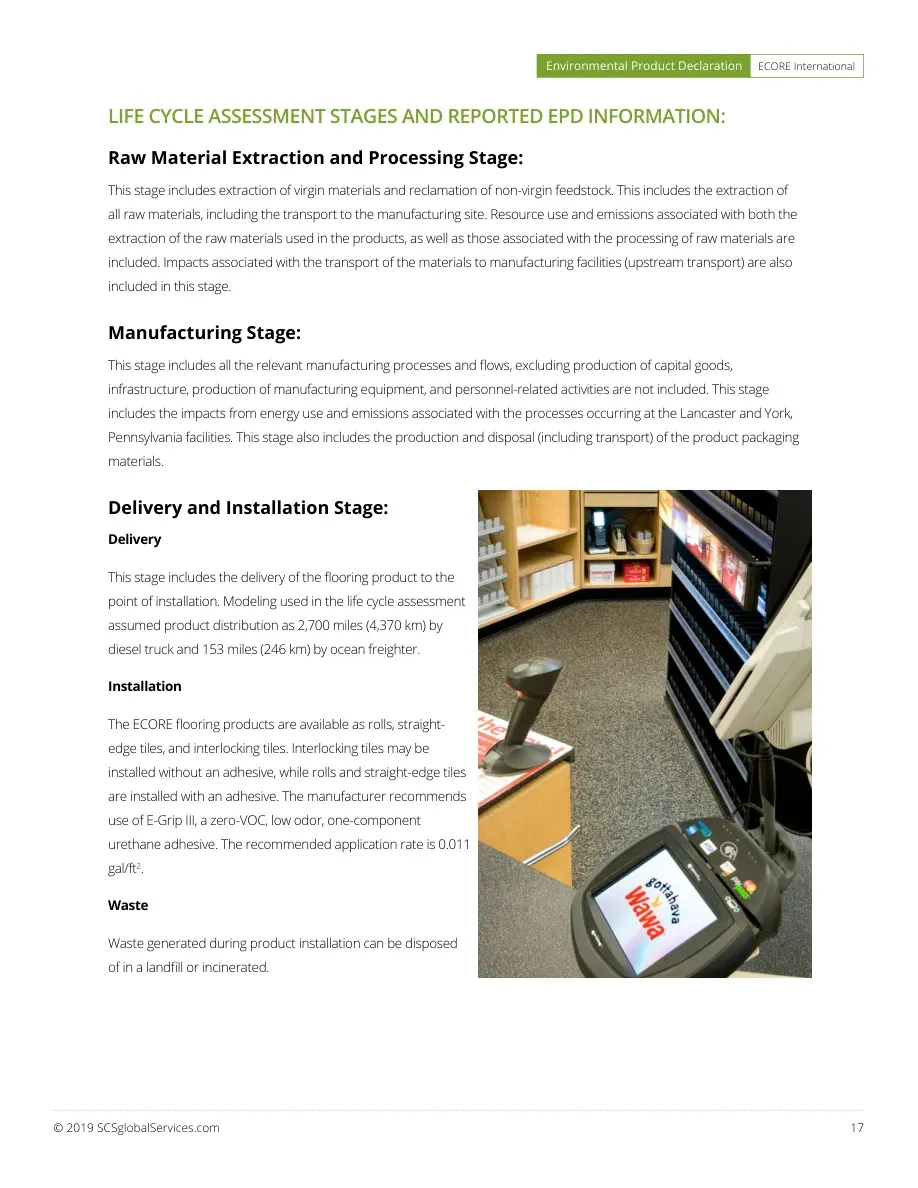
© 2019 SCSglobalServices.com 17 Environmental Product Declaration ECORE InternationalLIFE CYCLE ASSESSMENT STAGES AND REPORTED EPD INFORMATION:Raw Material Extraction and Processing Stage:This stage includes extraction of virgin materials and reclamation of non-virgin feedstock. This includes the extraction of all raw materials, including the transport to the manufacturing site. Resource use and emissions associated with both the extraction of the raw materials used in the products, as well as those associated with the processing of raw materials are included. Impacts associated with the transport of the materials to manufacturing facilities (upstream transport) are also included in this stage.Manufacturing Stage:This stage includes all the relevant manufacturing processes and flows, excluding production of capital goods, infrastructure, production of manufacturing equipment, and personnel-related activities are not included. This stage includes the impacts from energy use and emissions associated with the processes occurring at the Lancaster and York, Pennsylvania facilities. This stage also includes the production and disposal (including transport) of the product packaging materials.Delivery and Installation Stage:DeliveryThis stage includes the delivery of the flooring product to the point of installation. Modeling used in the life cycle assessment assumed product distribution as 2,700 miles (4,370 km) by diesel truck and 153 miles (246 km) by ocean freighter. InstallationThe ECORE flooring products are available as rolls, straight-edge tiles, and interlocking tiles. Interlocking tiles may be installed without an adhesive, while rolls and straight-edge tiles are installed with an adhesive. The manufacturer recommends use of E-Grip III, a zero-VOC, low odor, one-component urethane adhesive. The recommended application rate is 0.011 gal/ft2. WasteWaste generated during product installation can be disposed of in a landfill or incinerated.
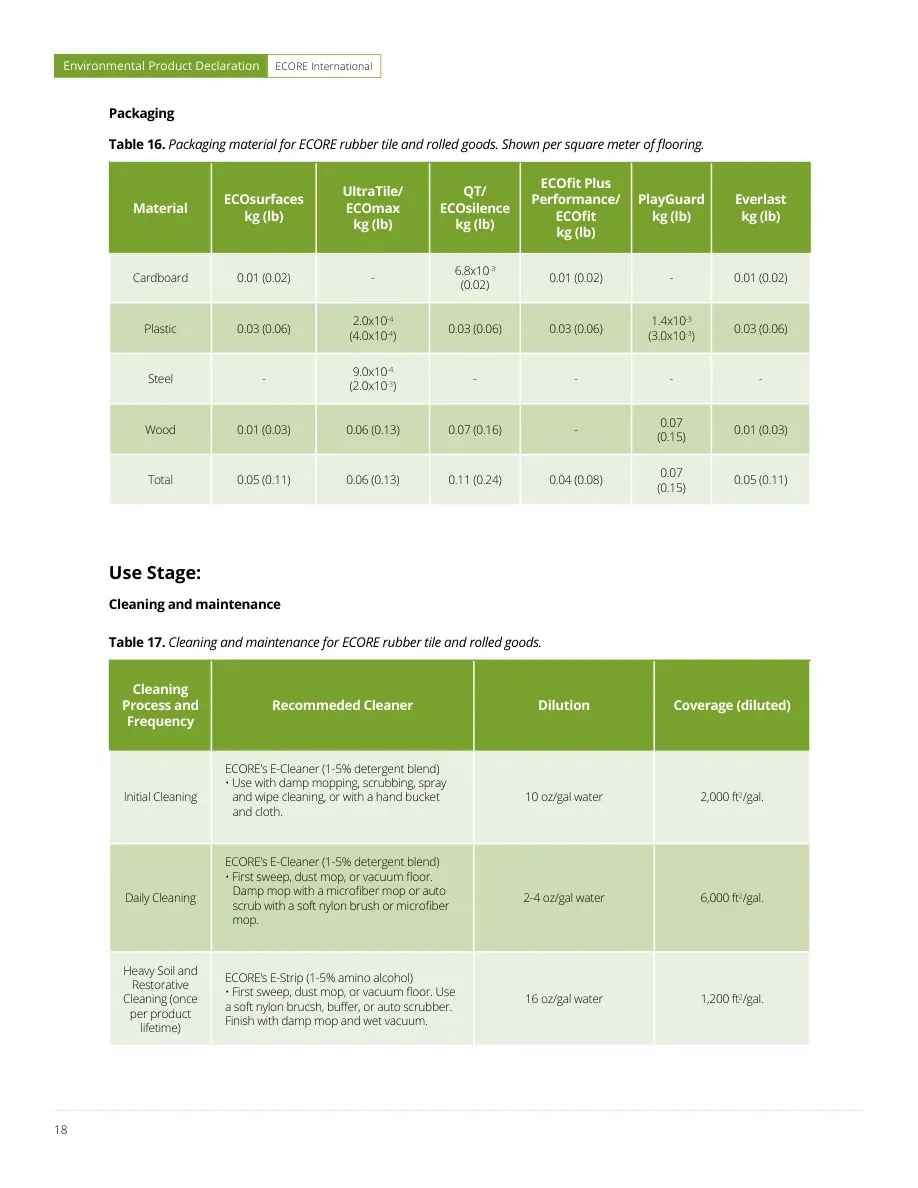
18 Environmental Product Declaration ECORE InternationalPackaging Table 16. Packaging material for ECORE rubber tile and rolled goods. Shown per square meter of flooring.Material ECOsurfaces kg (lb)UltraTile/ ECOmax kg (lb)QT/ ECOsilence kg (lb)ECOfit Plus Performance/ECOfit kg (lb)PlayGuard kg (lb)Everlast kg (lb)Cardboard0.01 (0.02)-6.8x10⁻³ (0.02)0.01 (0.02)-0.01 (0.02)Plastic0.03 (0.06)2.0x10⁻⁴ (4.0x10⁻⁴)0.03 (0.06)0.03 (0.06)1.4x10⁻³ (3.0x10⁻³)0.03 (0.06)Steel-9.0x10⁻⁴ (2.0x10⁻³)----Wood0.01 (0.03)0.06 (0.13)0.07 (0.16)-0.07 (0.15)0.01 (0.03)Total0.05 (0.11)0.06 (0.13)0.11 (0.24)0.04 (0.08)0.07 (0.15)0.05 (0.11)Use Stage: Cleaning and maintenance Table 17. Cleaning and maintenance for ECORE rubber tile and rolled goods.Cleaning Process and Frequency Recommeded CleanerDilutionCoverage (diluted)Initial CleaningECORE’s E-Cleaner (1-5% detergent blend)• Use with damp mopping, scrubbing, spray and wipe cleaning, or with a hand bucket and cloth.10 oz/gal water2,000 ft2/gal.Daily CleaningECORE’s E-Cleaner (1-5% detergent blend)• First sweep, dust mop, or vacuum floor. Damp mop with a microfiber mop or auto scrub with a soft nylon brush or microfiber mop. 2-4 oz/gal water6,000 ft2/gal.Heavy Soil and Restorative Cleaning (once per product lifetime)ECORE’s E-Strip (1-5% amino alcohol) • First sweep, dust mop, or vacuum floor. Use a soft nylon brucsh, buffer, or auto scrubber. Finish with damp mop and wet vacuum.16 oz/gal water1,200 ft2/gal.
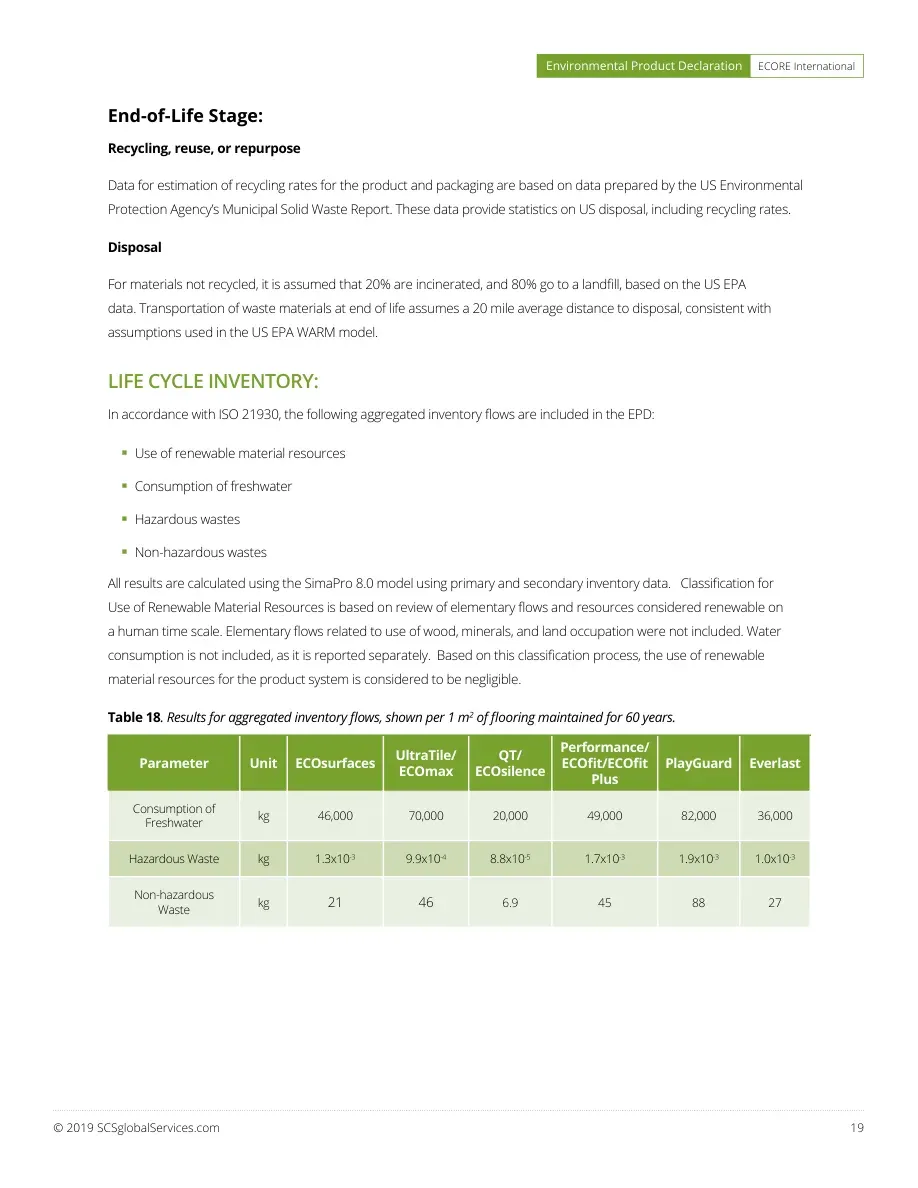
© 2019 SCSglobalServices.com 19 Environmental Product Declaration ECORE InternationalEnd-of-Life Stage:Recycling, reuse, or repurposeData for estimation of recycling rates for the product and packaging are based on data prepared by the US Environmental Protection Agency’s Municipal Solid Waste Report. These data provide statistics on US disposal, including recycling rates. DisposalFor materials not recycled, it is assumed that 20% are incinerated, and 80% go to a landfill, based on the US EPA data. Transportation of waste materials at end of life assumes a 20 mile average distance to disposal, consistent with assumptions used in the US EPA WARM model. LIFE CYCLE INVENTORY:In accordance with ISO 21930, the following aggregated inventory flows are included in the EPD:§§ Use of renewable material resources§§ Consumption of freshwater§§ Hazardous wastes§§ Non-hazardous wastesAll results are calculated using the SimaPro 8.0 model using primary and secondary inventory data. Classification for Use of Renewable Material Resources is based on review of elementary flows and resources considered renewable on a human time scale. Elementary flows related to use of wood, minerals, and land occupation were not included. Water consumption is not included, as it is reported separately. Based on this classification process, the use of renewable material resources for the product system is considered to be negligible. Table 18. Results for aggregated inventory flows, shown per 1 m2 of flooring maintained for 60 years.ParameterUnitECOsurfacesUltraTile/ ECOmaxQT/ ECOsilencePerformance/ ECOfit/ECOfit PlusPlayGuardEverlastConsumption of Freshwaterkg46,00070,00020,00049,00082,00036,000Hazardous Wastekg1.3x10-39.9x10-48.8x10-51.7x10-31.9x10-31.0x10⁻³Non-hazardous Wastekg21466.9458827
20 Environmental Product Declaration ECORE InternationalLIFE CYCLE IMPACT ASSESSMENT:Life cycle impact assessment is the process of converting the life cycle inventory results into a representation of environmental and human health impacts. For example, emissions such as carbon dioxide, methane, and nitrous oxide (inventory) together contribute to climate change (impact assessment). The impact assessment for the EPD is conducted in accordance with requirements of the PCR. Impact category indicators were estimated using the CML 2001 (Oct 2013) characterization method. Aggregated inventory flows for energy use and wastes were also calculated. The LCIA and inventory flow results were calculated using SimaPro 8.0.2 software.The ECORE products are available in a range of thicknesses and colors. For each product line, at least two versions of the product, representing an upper and lower extreme for the product line, were included in the LCA model. Table 19 shows the range in life cycle impact assessment results for each product line. Table 20 through Table 25 show results for 1 m2 of flooring, including extraction of raw materials through installation and end of life. Table 26 shows the average use stage impacts for 1 m2 of flooring over 1 year. Table 27 lists the assumptions used for product maintenance. Table 28 through Table 33 show the life cycle impact assessment results for 1 m2 of flooring over a 60 year period.
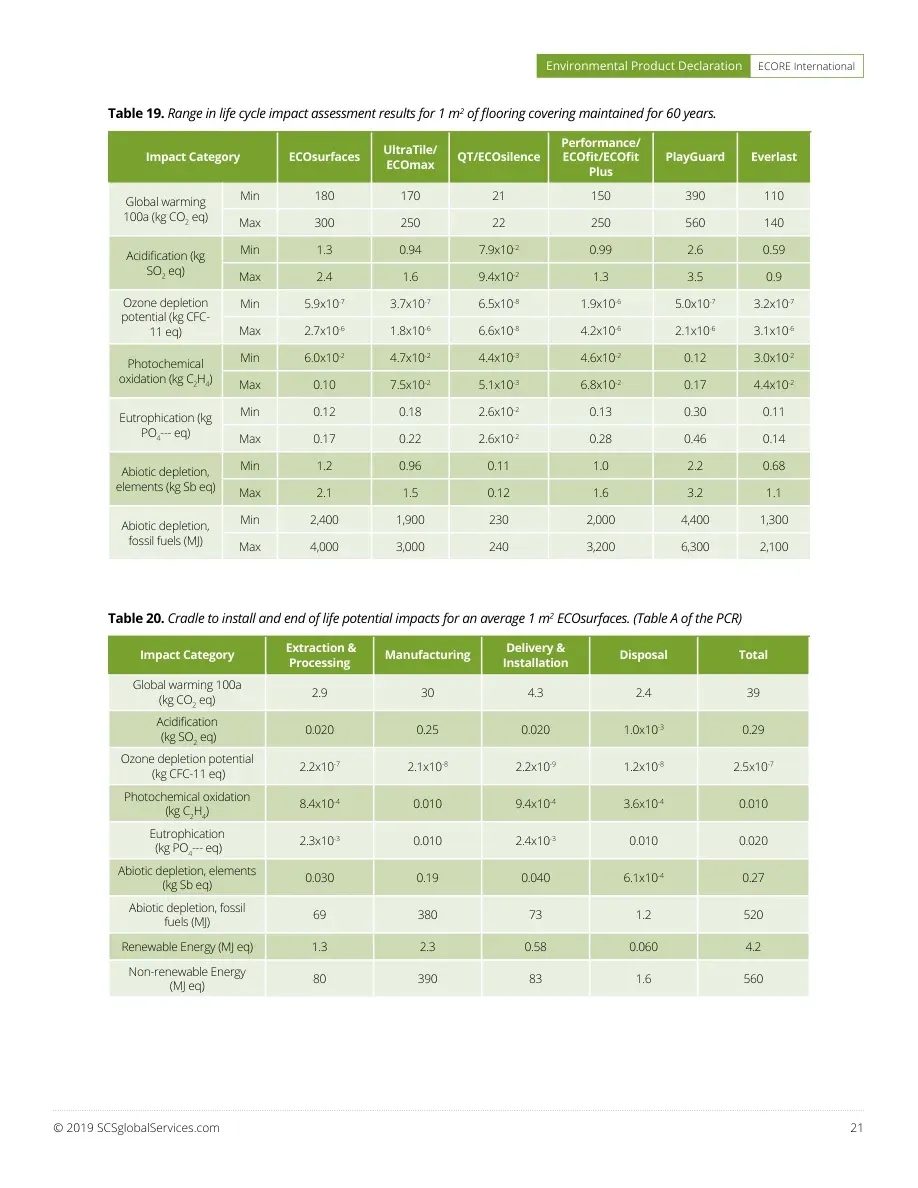
© 2019 SCSglobalServices.com 21 Environmental Product Declaration ECORE InternationalTable 19. Range in life cycle impact assessment results for 1 m2 of flooring covering maintained for 60 years.Impact CategoryECOsurfacesUltraTile/ECOmaxQT/ECOsilencePerformance/ECOfit/ECOfit PlusPlayGuardEverlastGlobal warming 100a (kg CO2 eq)Min18017021150390110Max30025022250560140Acidification (kg SO2 eq)Min1.30.947.9x10-20.992.60.59Max2.41.69.4x10-21.33.50.9Ozone depletion potential (kg CFC-11 eq)Min5.9x10-73.7x10-76.5x10-81.9x10-65.0x10-73.2x10-7Max2.7x10-61.8x10-66.6x10-84.2x10-62.1x10-63.1x10⁻⁶Photochemical oxidation (kg C2H4)Min6.0x10-24.7x10-24.4x10-34.6x10-20.123.0x10-2Max0.107.5x10-25.1x10-36.8x10-20.174.4x10-2Eutrophication (kg PO4--- eq)Min0.120.182.6x10-20.130.300.11Max0.170.222.6x10-20.280.460.14Abiotic depletion, elements (kg Sb eq)Min1.20.960.111.02.20.68Max2.11.50.121.63.21.1Abiotic depletion, fossil fuels (MJ)Min2,4001,9002302,0004,4001,300Max4,0003,0002403,2006,3002,100Table 20. Cradle to install and end of life potential impacts for an average 1 m2 ECOsurfaces. (Table A of the PCR)Impact Category Extraction & ProcessingManufacturingDelivery & InstallationDisposalTotalGlobal warming 100a (kg CO2 eq)2.9304.32.439Acidification (kg SO2 eq)0.0200.250.0201.0x10-30.29Ozone depletion potential (kg CFC-11 eq)2.2x10-72.1x10-82.2x10-91.2x10-82.5x10⁻⁷Photochemical oxidation (kg C2H4)8.4x10-40.0109.4x10-43.6x10-40.010Eutrophication (kg PO4--- eq)2.3x10-30.0102.4x10-30.0100.020Abiotic depletion, elements (kg Sb eq)0.0300.190.0406.1x10-40.27Abiotic depletion, fossil fuels (MJ)69380731.2520Renewable Energy (MJ eq)1.32.30.580.0604.2Non-renewable Energy (MJ eq)80390831.6560
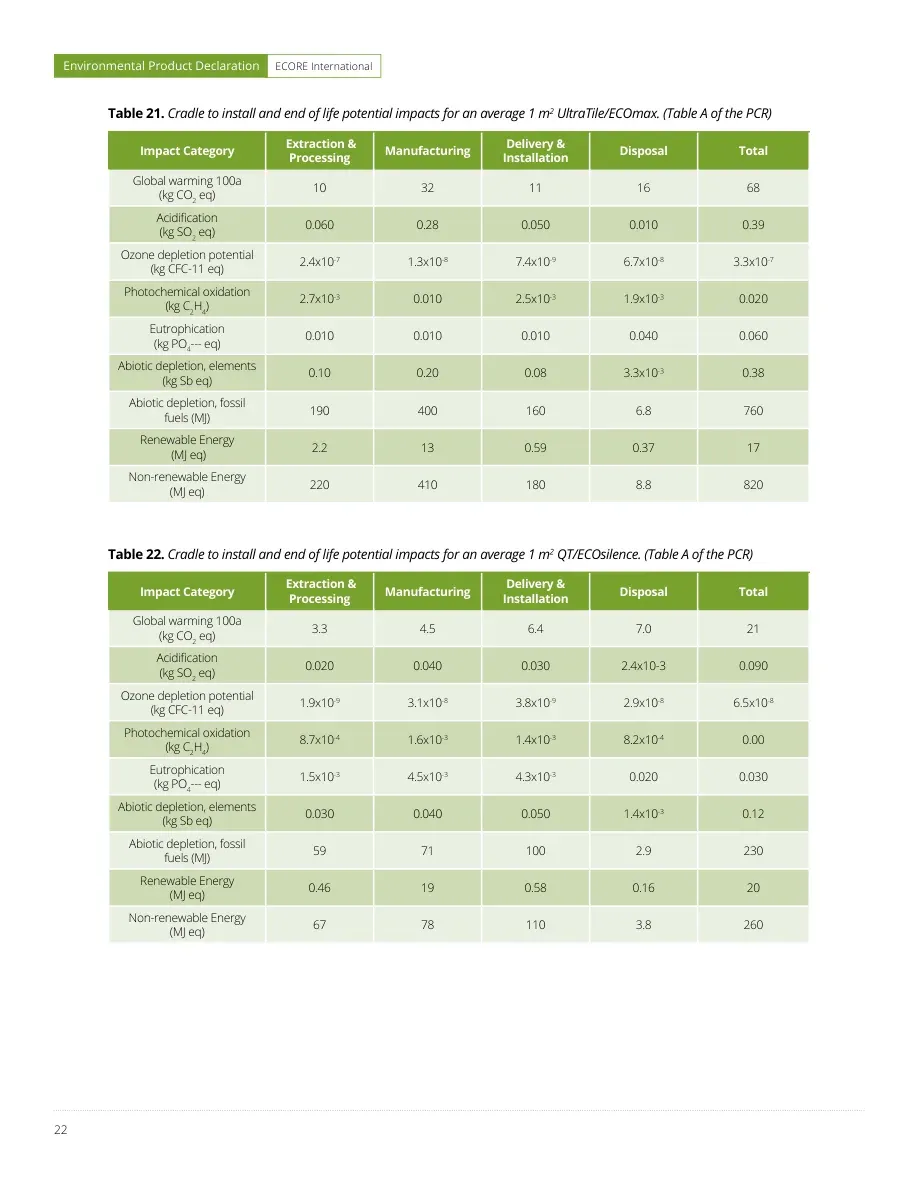
22 Environmental Product Declaration ECORE InternationalTable 21. Cradle to install and end of life potential impacts for an average 1 m2 UltraTile/ECOmax. (Table A of the PCR)Impact Category Extraction & ProcessingManufacturingDelivery & InstallationDisposalTotalGlobal warming 100a (kg CO2 eq)1032111668Acidification (kg SO2 eq)0.0600.280.0500.0100.39Ozone depletion potential (kg CFC-11 eq)2.4x10-71.3x10-87.4x10-96.7x10-83.3x10⁻⁷Photochemical oxidation (kg C2H4)2.7x10-30.0102.5x10-31.9x10-30.020Eutrophication (kg PO4--- eq)0.0100.0100.0100.0400.060Abiotic depletion, elements (kg Sb eq)0.100.200.083.3x10-30.38Abiotic depletion, fossil fuels (MJ)1904001606.8760Renewable Energy (MJ eq)2.2130.590.3717Non-renewable Energy (MJ eq)2204101808.8820Table 22. Cradle to install and end of life potential impacts for an average 1 m2 QT/ECOsilence. (Table A of the PCR)Impact Category Extraction & ProcessingManufacturingDelivery & InstallationDisposalTotalGlobal warming 100a (kg CO2 eq)3.34.56.47.021Acidification (kg SO2 eq)0.0200.0400.0302.4x10-30.090Ozone depletion potential (kg CFC-11 eq)1.9x10-93.1x10-83.8x10-92.9x10-86.5x10⁻⁸Photochemical oxidation (kg C2H4)8.7x10-41.6x10-31.4x10-38.2x10-40.00Eutrophication (kg PO4--- eq)1.5x10-34.5x10-34.3x10-30.0200.030Abiotic depletion, elements (kg Sb eq)0.0300.0400.0501.4x10-30.12Abiotic depletion, fossil fuels (MJ)59711002.9230Renewable Energy (MJ eq)0.46190.580.1620Non-renewable Energy (MJ eq)67781103.8260
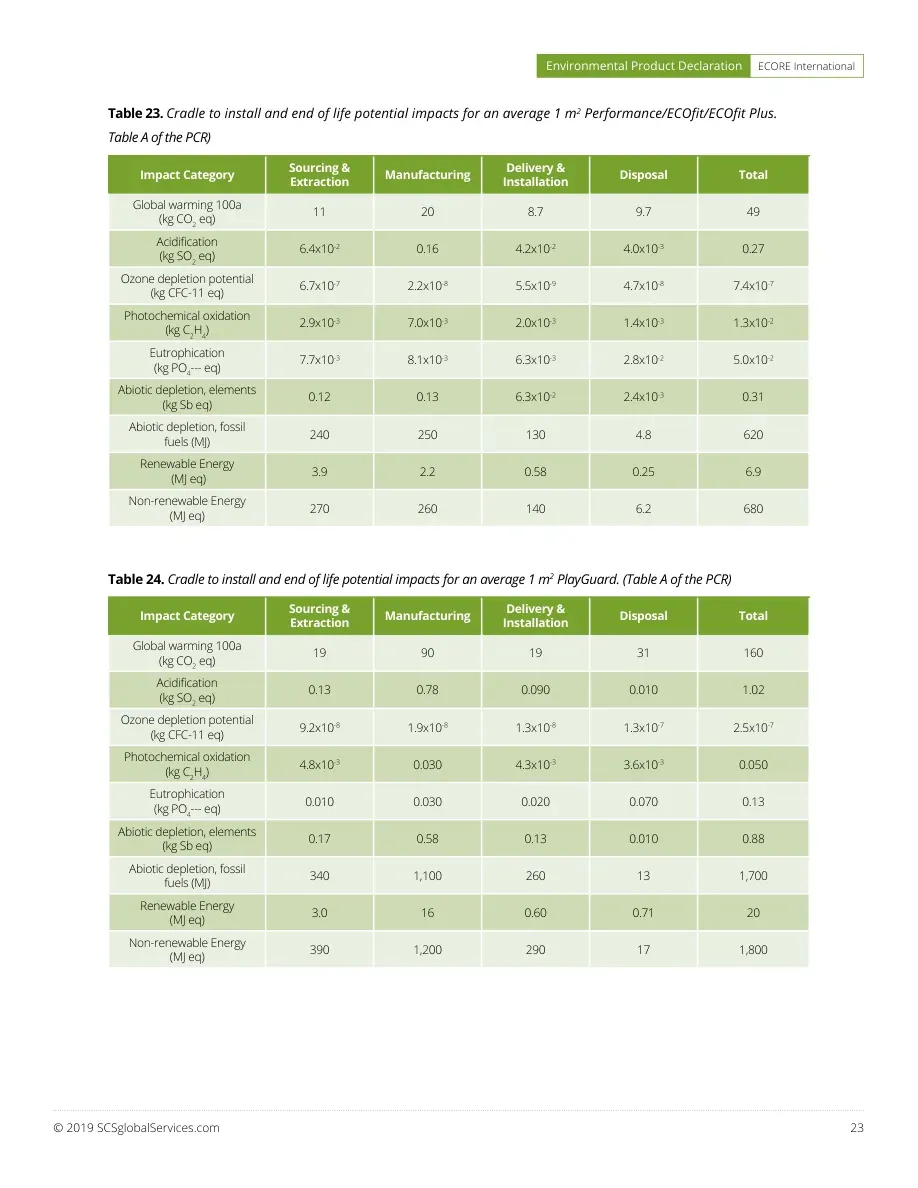
© 2019 SCSglobalServices.com 23 Environmental Product Declaration ECORE InternationalTable 23. Cradle to install and end of life potential impacts for an average 1 m2 Performance/ECOfit/ECOfit Plus. Table A of the PCR) Impact CategorySourcing & ExtractionManufacturingDelivery & InstallationDisposalTotalGlobal warming 100a (kg CO2 eq)11208.79.749Acidification (kg SO2 eq)6.4x10-20.164.2x10-24.0x10-30.27Ozone depletion potential (kg CFC-11 eq)6.7x10-72.2x10-85.5x10-94.7x10-87.4x10⁻⁷Photochemical oxidation (kg C2H4)2.9x10-37.0x10-32.0x10-31.4x10-31.3x10⁻²Eutrophication (kg PO4--- eq)7.7x10-38.1x10-36.3x10-32.8x10-25.0x10⁻²Abiotic depletion, elements (kg Sb eq)0.120.136.3x10-22.4x10-30.31Abiotic depletion, fossil fuels (MJ)2402501304.8620Renewable Energy (MJ eq)3.92.20.580.256.9Non-renewable Energy (MJ eq)2702601406.2680Table 24. Cradle to install and end of life potential impacts for an average 1 m2 PlayGuard. (Table A of the PCR)Impact CategorySourcing & ExtractionManufacturingDelivery & InstallationDisposalTotalGlobal warming 100a (kg CO2 eq)19901931160Acidification (kg SO2 eq)0.130.780.0900.0101.02Ozone depletion potential (kg CFC-11 eq)9.2x10-81.9x10-81.3x10-81.3x10-72.5x10⁻⁷Photochemical oxidation (kg C2H4)4.8x10-30.0304.3x10-33.6x10-30.050Eutrophication (kg PO4--- eq)0.0100.0300.0200.0700.13Abiotic depletion, elements (kg Sb eq)0.170.580.130.0100.88Abiotic depletion, fossil fuels (MJ)3401,100260131,700Renewable Energy (MJ eq)3.0160.600.7120Non-renewable Energy (MJ eq)3901,200290171,800
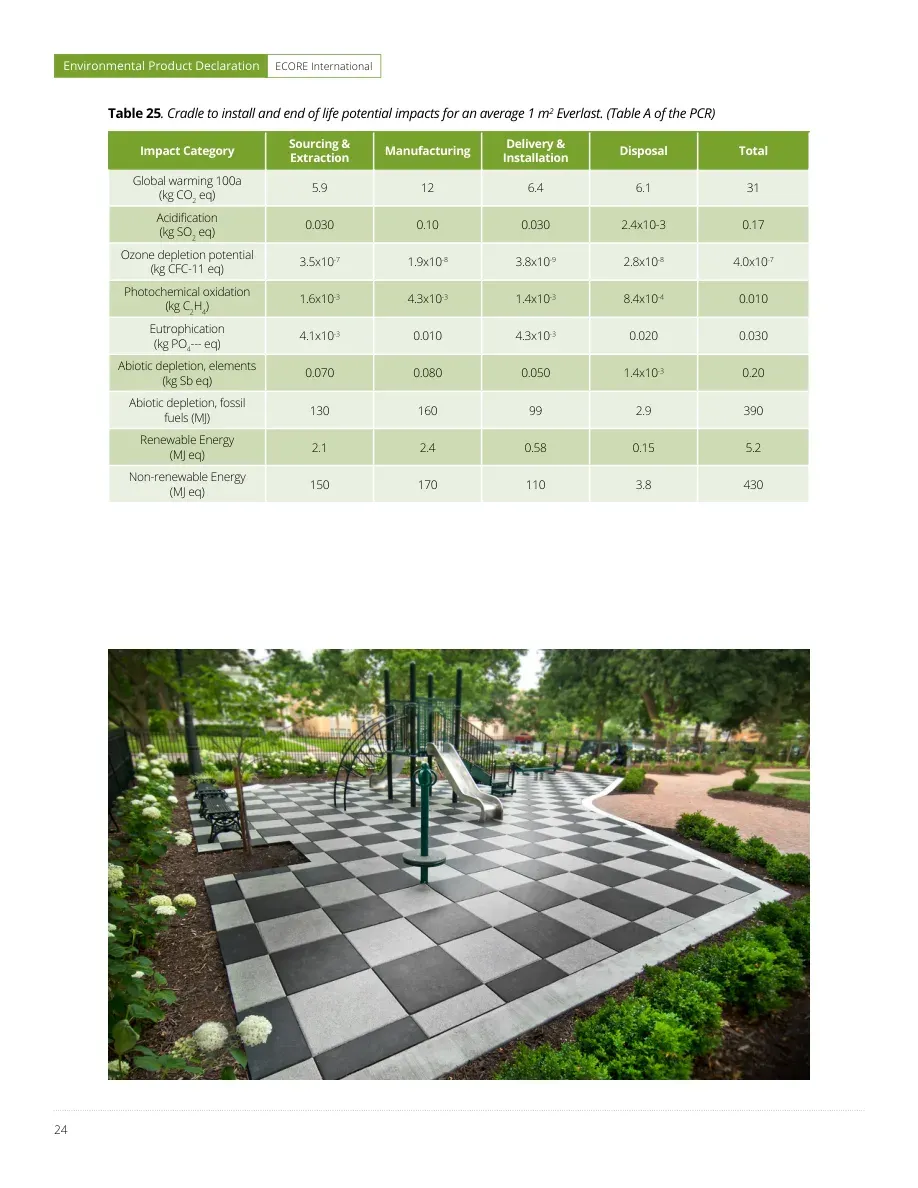
24 Environmental Product Declaration ECORE InternationalTable 25. Cradle to install and end of life potential impacts for an average 1 m2 Everlast. (Table A of the PCR)Impact CategorySourcing & ExtractionManufacturingDelivery & InstallationDisposalTotalGlobal warming 100a (kg CO2 eq)5.9126.46.131Acidification (kg SO2 eq)0.0300.100.0302.4x10-30.17Ozone depletion potential (kg CFC-11 eq)3.5x10-71.9x10-83.8x10-92.8x10-84.0x10⁻⁷Photochemical oxidation (kg C2H4)1.6x10-34.3x10-31.4x10-38.4x10-40.010Eutrophication (kg PO4--- eq)4.1x10-30.0104.3x10-30.0200.030Abiotic depletion, elements (kg Sb eq)0.0700.0800.0501.4x10-30.20Abiotic depletion, fossil fuels (MJ)130160992.9390Renewable Energy (MJ eq)2.12.40.580.155.2Non-renewable Energy (MJ eq)1501701103.8430
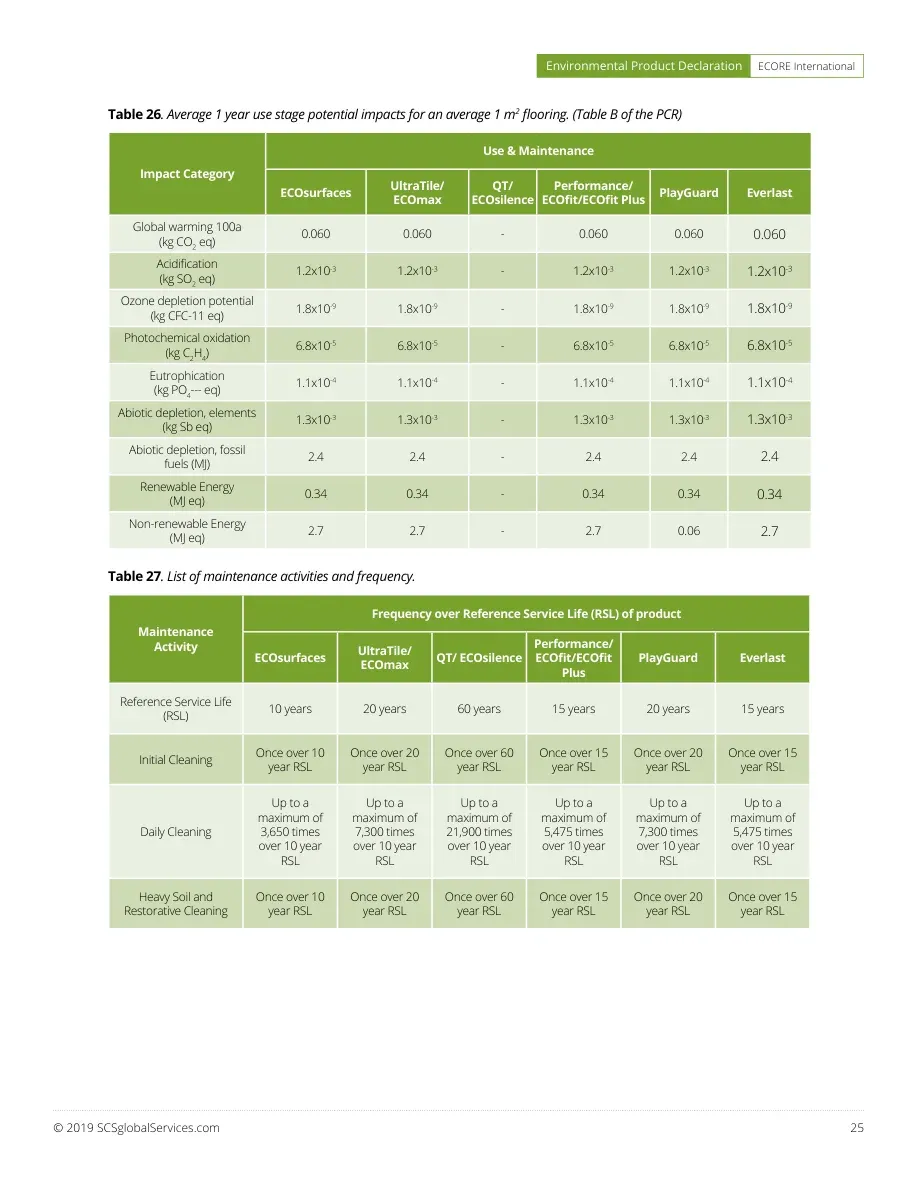
© 2019 SCSglobalServices.com 25 Environmental Product Declaration ECORE InternationalTable 26. Average 1 year use stage potential impacts for an average 1 m2 flooring. (Table B of the PCR)Impact CategoryUse & MaintenanceECOsurfacesUltraTile/ ECOmaxQT/ ECOsilencePerformance/ ECOfit/ECOfit PlusPlayGuardEverlastGlobal warming 100a (kg CO2 eq)0.0600.060-0.0600.0600.060Acidification (kg SO2 eq)1.2x10-31.2x10-3-1.2x10-31.2x10-31.2x10⁻³Ozone depletion potential (kg CFC-11 eq)1.8x10-91.8x10-9-1.8x10-91.8x10-91.8x10⁻⁹Photochemical oxidation (kg C2H4)6.8x10-56.8x10-5-6.8x10-56.8x10-56.8x10⁻⁵Eutrophication (kg PO4--- eq)1.1x10-41.1x10-4-1.1x10-41.1x10-41.1x10⁻⁴Abiotic depletion, elements (kg Sb eq)1.3x10-31.3x10-3-1.3x10-31.3x10-31.3x10⁻³Abiotic depletion, fossil fuels (MJ)2.42.4-2.42.42.4Renewable Energy (MJ eq)0.340.34-0.340.340.34Non-renewable Energy (MJ eq)2.72.7-2.70.062.7Table 27. List of maintenance activities and frequency. Maintenance ActivityFrequency over Reference Service Life (RSL) of productECOsurfacesUltraTile/ ECOmaxQT/ ECOsilencePerformance/ ECOfit/ECOfit PlusPlayGuardEverlastReference Service Life (RSL)10 years20 years60 years15 years20 years15 yearsInitial CleaningOnce over 10 year RSLOnce over 20 year RSLOnce over 60 year RSLOnce over 15 year RSLOnce over 20 year RSLOnce over 15 year RSLDaily CleaningUp to a maximum of 3,650 times over 10 year RSLUp to a maximum of 7,300 times over 10 year RSLUp to a maximum of 21,900 times over 10 year RSLUp to a maximum of 5,475 times over 10 year RSLUp to a maximum of 7,300 times over 10 year RSLUp to a maximum of 5,475 times over 10 year RSLHeavy Soil and Restorative CleaningOnce over 10 year RSLOnce over 20 year RSLOnce over 60 year RSLOnce over 15 year RSLOnce over 20 year RSLOnce over 15 year RSL
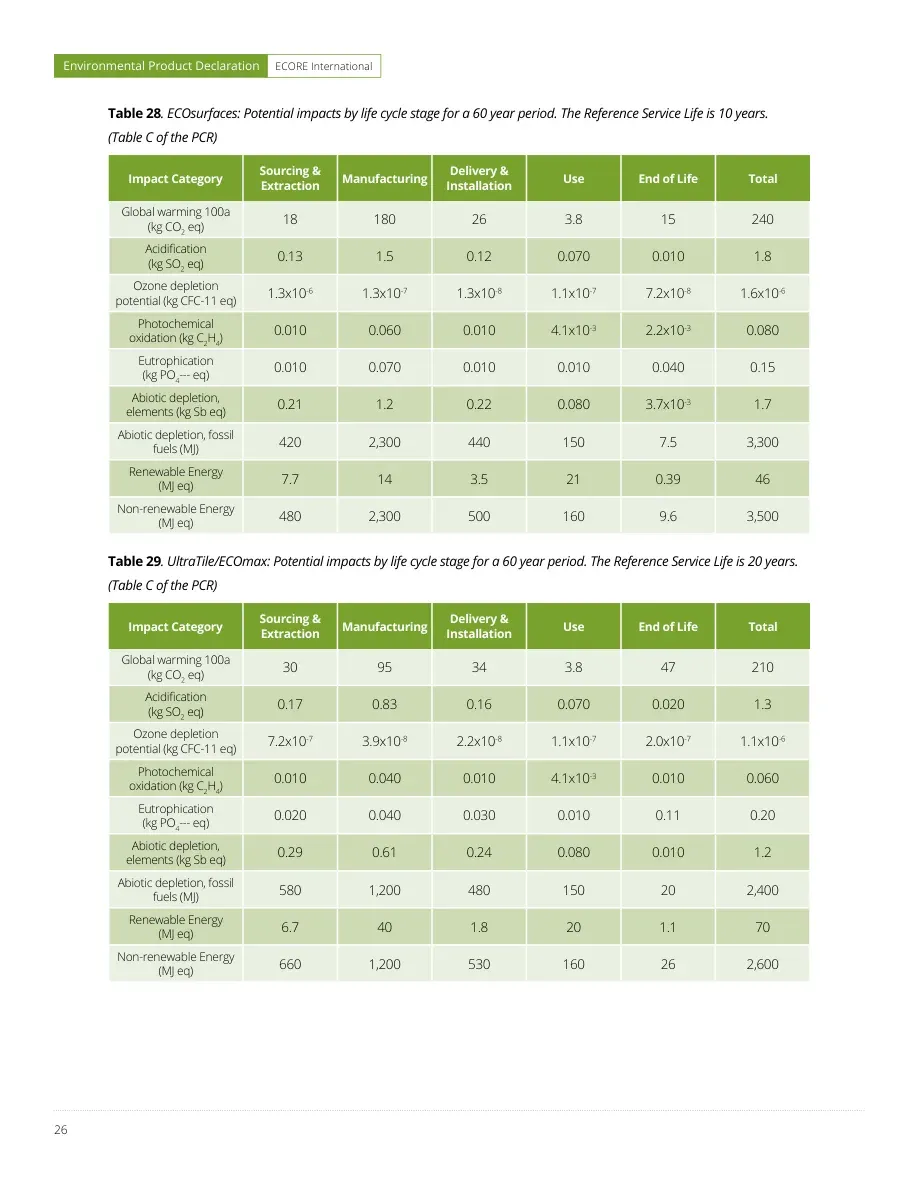
26 Environmental Product Declaration ECORE InternationalTable 28. ECOsurfaces: Potential impacts by life cycle stage for a 60 year period. The Reference Service Life is 10 years. (Table C of the PCR)Impact CategorySourcing & ExtractionManufacturingDelivery & InstallationUseEnd of LifeTotalGlobal warming 100a (kg CO2 eq)18180263.815240Acidification (kg SO2 eq)0.131.50.120.0700.0101.8Ozone depletion potential (kg CFC-11 eq)1.3x10-61.3x10-71.3x10-81.1x10-77.2x10-81.6x10-6Photochemical oxidation (kg C2H4)0.0100.0600.0104.1x10-32.2x10-30.080Eutrophication (kg PO4--- eq)0.0100.0700.0100.0100.0400.15Abiotic depletion, elements (kg Sb eq)0.211.20.220.0803.7x10-31.7Abiotic depletion, fossil fuels (MJ)4202,3004401507.53,300Renewable Energy (MJ eq)7.7143.5210.3946Non-renewable Energy (MJ eq)4802,3005001609.63,500Table 29. UltraTile/ECOmax: Potential impacts by life cycle stage for a 60 year period. The Reference Service Life is 20 years. (Table C of the PCR)Impact CategorySourcing & ExtractionManufacturingDelivery & InstallationUseEnd of LifeTotalGlobal warming 100a (kg CO2 eq)3095343.847210Acidification (kg SO2 eq)0.170.830.160.0700.0201.3Ozone depletion potential (kg CFC-11 eq)7.2x10-73.9x10-82.2x10-81.1x10-72.0x10-71.1x10-6Photochemical oxidation (kg C2H4)0.0100.0400.0104.1x10-30.0100.060Eutrophication (kg PO4--- eq)0.0200.0400.0300.0100.110.20Abiotic depletion, elements (kg Sb eq)0.290.610.240.0800.0101.2Abiotic depletion, fossil fuels (MJ)5801,200480150202,400Renewable Energy (MJ eq)6.7401.8201.170Non-renewable Energy (MJ eq)6601,200530160262,600
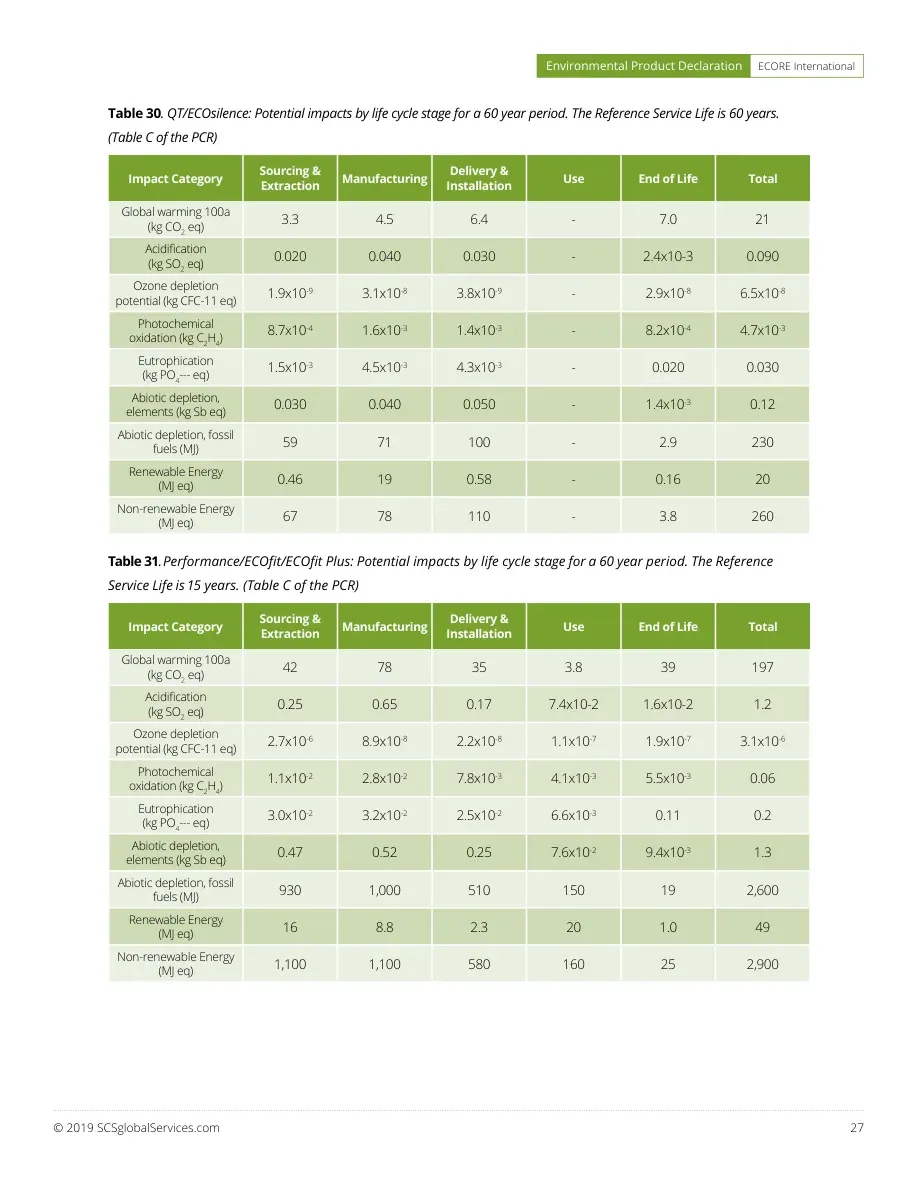
© 2019 SCSglobalServices.com 27 Environmental Product Declaration ECORE InternationalTable 30. QT/ECOsilence: Potential impacts by life cycle stage for a 60 year period. The Reference Service Life is 60 years. (Table C of the PCR)Impact CategorySourcing & ExtractionManufacturingDelivery & InstallationUseEnd of LifeTotalGlobal warming 100a (kg CO2 eq)3.34.56.4-7.021Acidification (kg SO2 eq)0.0200.0400.030-2.4x10-30.090Ozone depletion potential (kg CFC-11 eq)1.9x10-93.1x10-83.8x10⁻⁹-2.9x10-86.5x10-8Photochemical oxidation (kg C2H4)8.7x10-41.6x10-31.4x10⁻³-8.2x10-44.7x10-3Eutrophication (kg PO4--- eq)1.5x10-34.5x10-34.3x10⁻³-0.0200.030Abiotic depletion, elements (kg Sb eq)0.0300.0400.050-1.4x10-30.12Abiotic depletion, fossil fuels (MJ)5971100-2.9230Renewable Energy (MJ eq)0.46190.58-0.1620Non-renewable Energy (MJ eq)6778110-3.8260Table 31. Performance/ECOfit/ECOfit Plus: Potential impacts by life cycle stage for a 60 year period. The Reference Service Life is 15 years. (Table C of the PCR)Impact CategorySourcing & ExtractionManufacturingDelivery & InstallationUseEnd of LifeTotalGlobal warming 100a (kg CO2 eq)4278353.839197Acidification (kg SO2 eq)0.250.650.177.4x10-21.6x10-21.2Ozone depletion potential (kg CFC-11 eq)2.7x10-68.9x10-82.2x10-81.1x10-71.9x10-73.1x10-6Photochemical oxidation (kg C2H4)1.1x10-22.8x10-27.8x10-34.1x10-35.5x10-30.06Eutrophication (kg PO4--- eq)3.0x10-23.2x10-22.5x10-26.6x10-30.110.2Abiotic depletion, elements (kg Sb eq)0.470.520.257.6x10-29.4x10-31.3Abiotic depletion, fossil fuels (MJ)9301,000510150192,600Renewable Energy (MJ eq)168.82.3201.049Non-renewable Energy (MJ eq)1,1001,100580160252,900
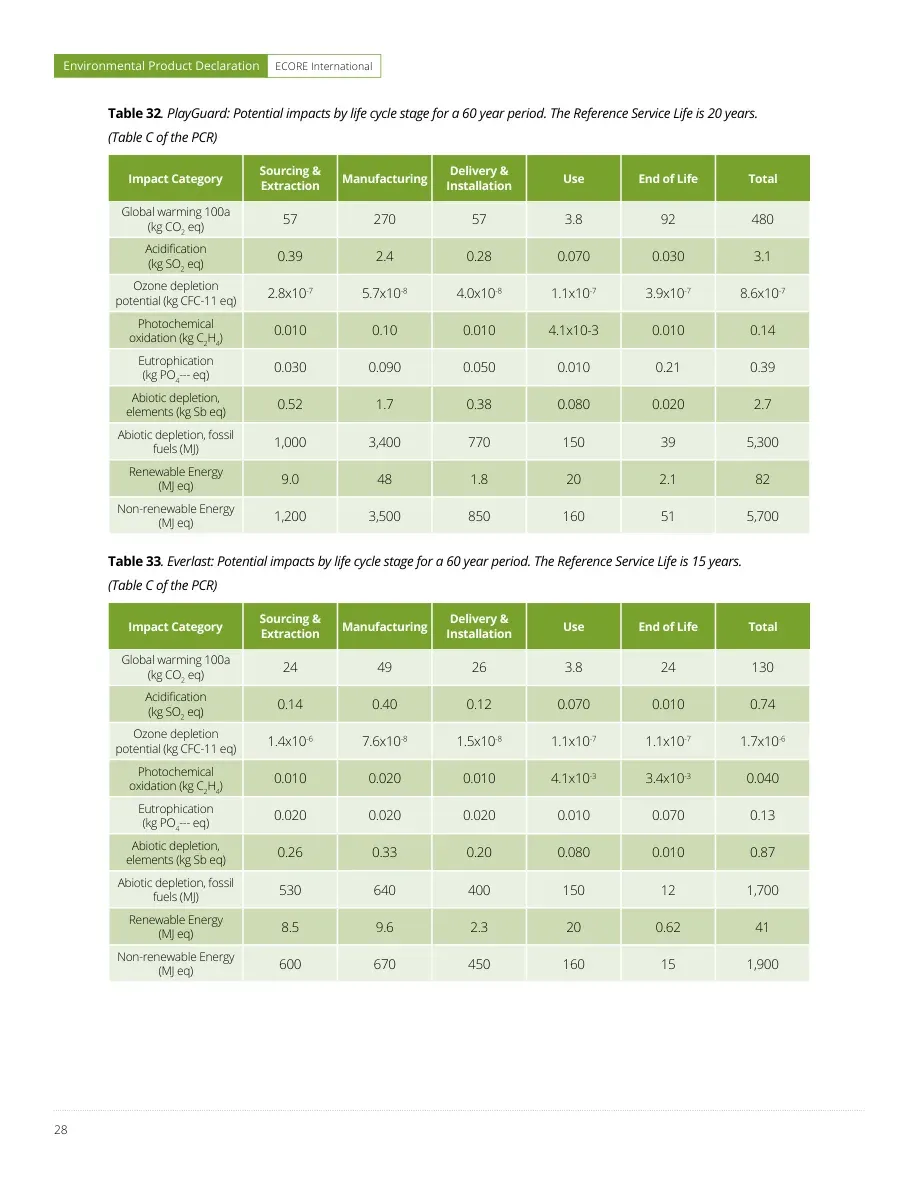
28 Environmental Product Declaration ECORE InternationalTable 32. PlayGuard: Potential impacts by life cycle stage for a 60 year period. The Reference Service Life is 20 years. (Table C of the PCR)Impact CategorySourcing & ExtractionManufacturingDelivery & InstallationUseEnd of LifeTotalGlobal warming 100a (kg CO2 eq)57270573.892480Acidification (kg SO2 eq)0.392.40.280.0700.0303.1Ozone depletion potential (kg CFC-11 eq)2.8x10-75.7x10-84.0x10-81.1x10-73.9x10-78.6x10-7Photochemical oxidation (kg C2H4)0.0100.100.0104.1x10-30.0100.14Eutrophication (kg PO4--- eq)0.0300.0900.0500.0100.210.39Abiotic depletion, elements (kg Sb eq)0.521.70.380.0800.0202.7Abiotic depletion, fossil fuels (MJ)1,0003,400770150395,300Renewable Energy (MJ eq)9.0481.8202.182Non-renewable Energy (MJ eq)1,2003,500850160515,700Table 33. Everlast: Potential impacts by life cycle stage for a 60 year period. The Reference Service Life is 15 years. (Table C of the PCR)Impact CategorySourcing & ExtractionManufacturingDelivery & InstallationUseEnd of LifeTotalGlobal warming 100a (kg CO2 eq)2449263.824130Acidification (kg SO2 eq)0.140.400.120.0700.0100.74Ozone depletion potential (kg CFC-11 eq)1.4x10-67.6x10-81.5x10-81.1x10-71.1x10-71.7x10-6Photochemical oxidation (kg C2H4)0.0100.0200.0104.1x10-33.4x10-30.040Eutrophication (kg PO4--- eq)0.0200.0200.0200.0100.0700.13Abiotic depletion, elements (kg Sb eq)0.260.330.200.0800.0100.87Abiotic depletion, fossil fuels (MJ)530640400150121,700Renewable Energy (MJ eq)8.59.62.3200.6241Non-renewable Energy (MJ eq)600670450160151,900
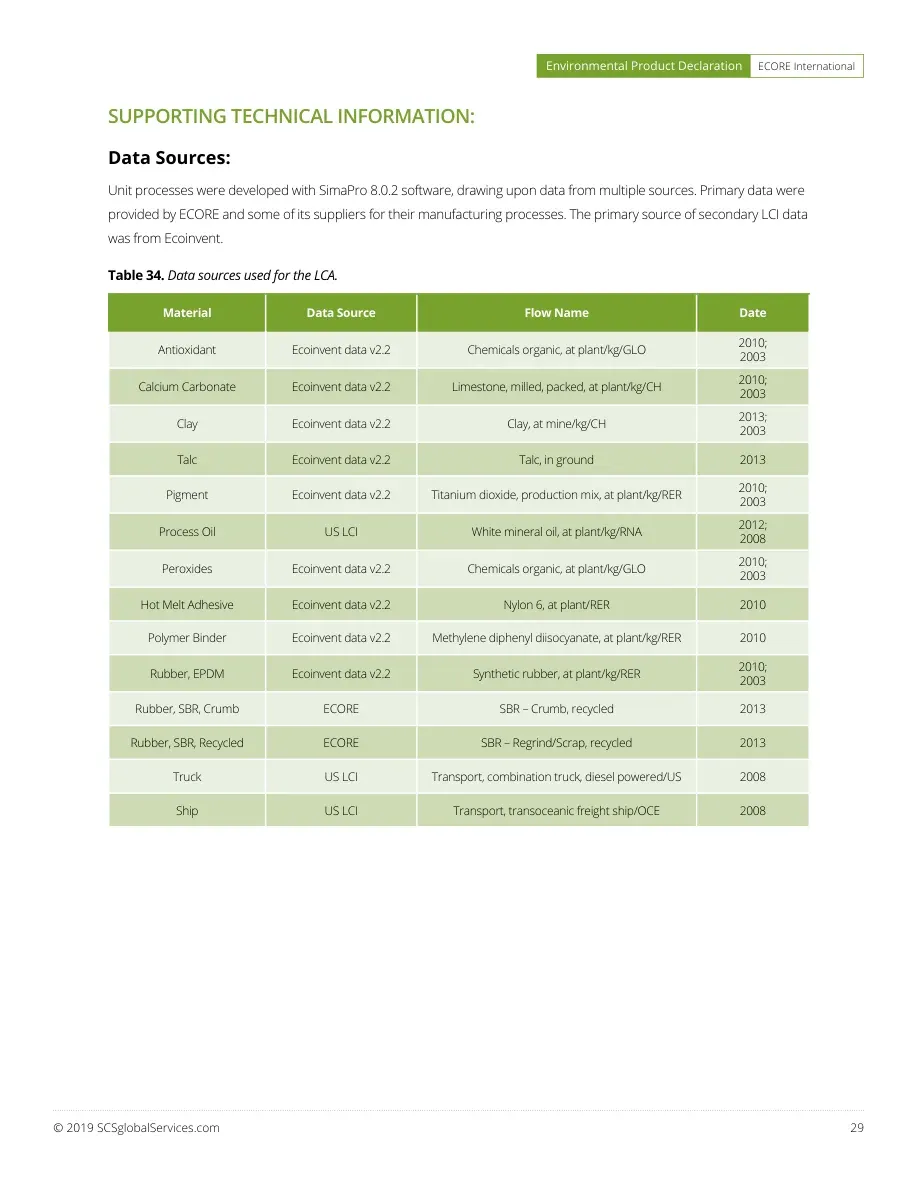
© 2019 SCSglobalServices.com 29 Environmental Product Declaration ECORE InternationalSUPPORTING TECHNICAL INFORMATION:Data Sources:Unit processes were developed with SimaPro 8.0.2 software, drawing upon data from multiple sources. Primary data were provided by ECORE and some of its suppliers for their manufacturing processes. The primary source of secondary LCI data was from Ecoinvent. Table 34. Data sources used for the LCA.MaterialData SourceFlow NameDateAntioxidantEcoinvent data v2.2Chemicals organic, at plant/kg/GLO2010; 2003Calcium CarbonateEcoinvent data v2.2Limestone, milled, packed, at plant/kg/CH2010; 2003ClayEcoinvent data v2.2Clay, at mine/kg/CH2013; 2003TalcEcoinvent data v2.2 Talc, in ground2013PigmentEcoinvent data v2.2Titanium dioxide, production mix, at plant/kg/RER2010; 2003Process OilUS LCIWhite mineral oil, at plant/kg/RNA2012; 2008PeroxidesEcoinvent data v2.2Chemicals organic, at plant/kg/GLO2010; 2003Hot Melt AdhesiveEcoinvent data v2.2Nylon 6, at plant/RER2010Polymer BinderEcoinvent data v2.2Methylene diphenyl diisocyanate, at plant/kg/RER2010Rubber, EPDMEcoinvent data v2.2Synthetic rubber, at plant/kg/RER2010; 2003Rubber, SBR, CrumbECORE SBR – Crumb, recycled2013Rubber, SBR, RecycledECORE SBR – Regrind/Scrap, recycled2013TruckUS LCITransport, combination truck, diesel powered/US2008ShipUS LCITransport, transoceanic freight ship/OCE2008
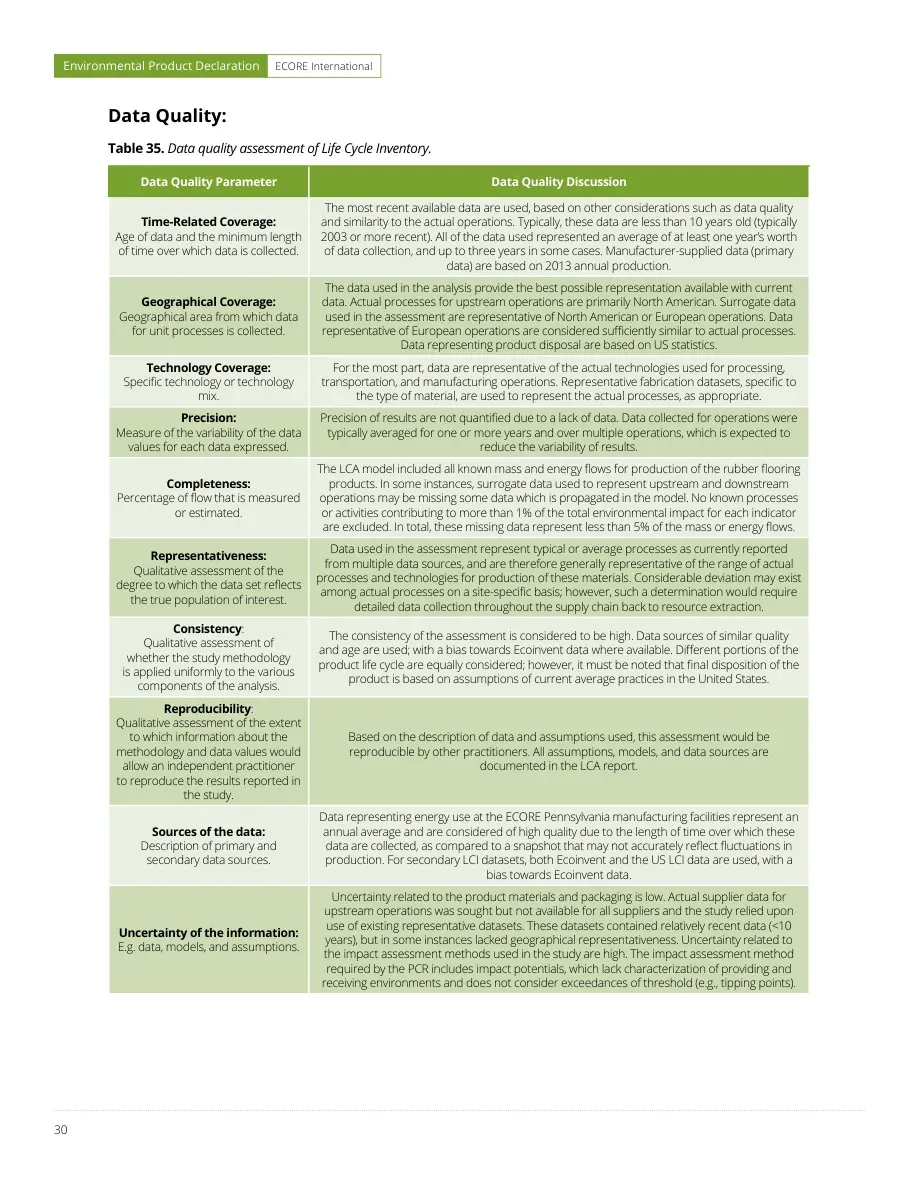
30 Environmental Product Declaration ECORE InternationalData Quality:Table 35. Data quality assessment of Life Cycle Inventory.Data Quality ParameterData Quality DiscussionTime-Related Coverage: Age of data and the minimum length of time over which data is collected.The most recent available data are used, based on other considerations such as data quality and similarity to the actual operations. Typically, these data are less than 10 years old (typically 2003 or more recent). All of the data used represented an average of at least one year’s worth of data collection, and up to three years in some cases. Manufacturer-supplied data (primary data) are based on 2013 annual production.Geographical Coverage: Geographical area from which data for unit processes is collected.The data used in the analysis provide the best possible representation available with current data. Actual processes for upstream operations are primarily North American. Surrogate data used in the assessment are representative of North American or European operations. Data representative of European operations are considered sufficiently similar to actual processes. Data representing product disposal are based on US statistics. Technology Coverage:Specific technology or technology mix. For the most part, data are representative of the actual technologies used for processing, transportation, and manufacturing operations. Representative fabrication datasets, specific to the type of material, are used to represent the actual processes, as appropriate.Precision:Measure of the variability of the data values for each data expressed.Precision of results are not quantified due to a lack of data. Data collected for operations were typically averaged for one or more years and over multiple operations, which is expected to reduce the variability of results. Completeness:Percentage of flow that is measured or estimated.The LCA model included all known mass and energy flows for production of the rubber flooring products. In some instances, surrogate data used to represent upstream and downstream operations may be missing some data which is propagated in the model. No known processes or activities contributing to more than 1% of the total environmental impact for each indicator are excluded. In total, these missing data represent less than 5% of the mass or energy flows. Representativeness:Qualitative assessment of the degree to which the data set reflects the true population of interest.Data used in the assessment represent typical or average processes as currently reported from multiple data sources, and are therefore generally representative of the range of actual processes and technologies for production of these materials. Considerable deviation may exist among actual processes on a site-specific basis; however, such a determination would require detailed data collection throughout the supply chain back to resource extraction. Consistency:Qualitative assessment of whether the study methodology is applied uniformly to the various components of the analysis.The consistency of the assessment is considered to be high. Data sources of similar quality and age are used; with a bias towards Ecoinvent data where available. Different portions of the product life cycle are equally considered; however, it must be noted that final disposition of the product is based on assumptions of current average practices in the United States. Reproducibility:Qualitative assessment of the extent to which information about the methodology and data values would allow an independent practitioner to reproduce the results reported in the study.Based on the description of data and assumptions used, this assessment would be reproducible by other practitioners. All assumptions, models, and data sources are documented in the LCA report. Sources of the data:Description of primary and secondary data sources.Data representing energy use at the ECORE Pennsylvania manufacturing facilities represent an annual average and are considered of high quality due to the length of time over which these data are collected, as compared to a snapshot that may not accurately reflect fluctuations in production. For secondary LCI datasets, both Ecoinvent and the US LCI data are used, with a bias towards Ecoinvent data.Uncertainty of the information:E.g. data, models, and assumptions.Uncertainty related to the product materials and packaging is low. Actual supplier data for upstream operations was sought but not available for all suppliers and the study relied upon use of existing representative datasets. These datasets contained relatively recent data (<10 years), but in some instances lacked geographical representativeness. Uncertainty related to the impact assessment methods used in the study are high. The impact assessment method required by the PCR includes impact potentials, which lack characterization of providing and receiving environments and does not consider exceedances of threshold (e.g., tipping points).
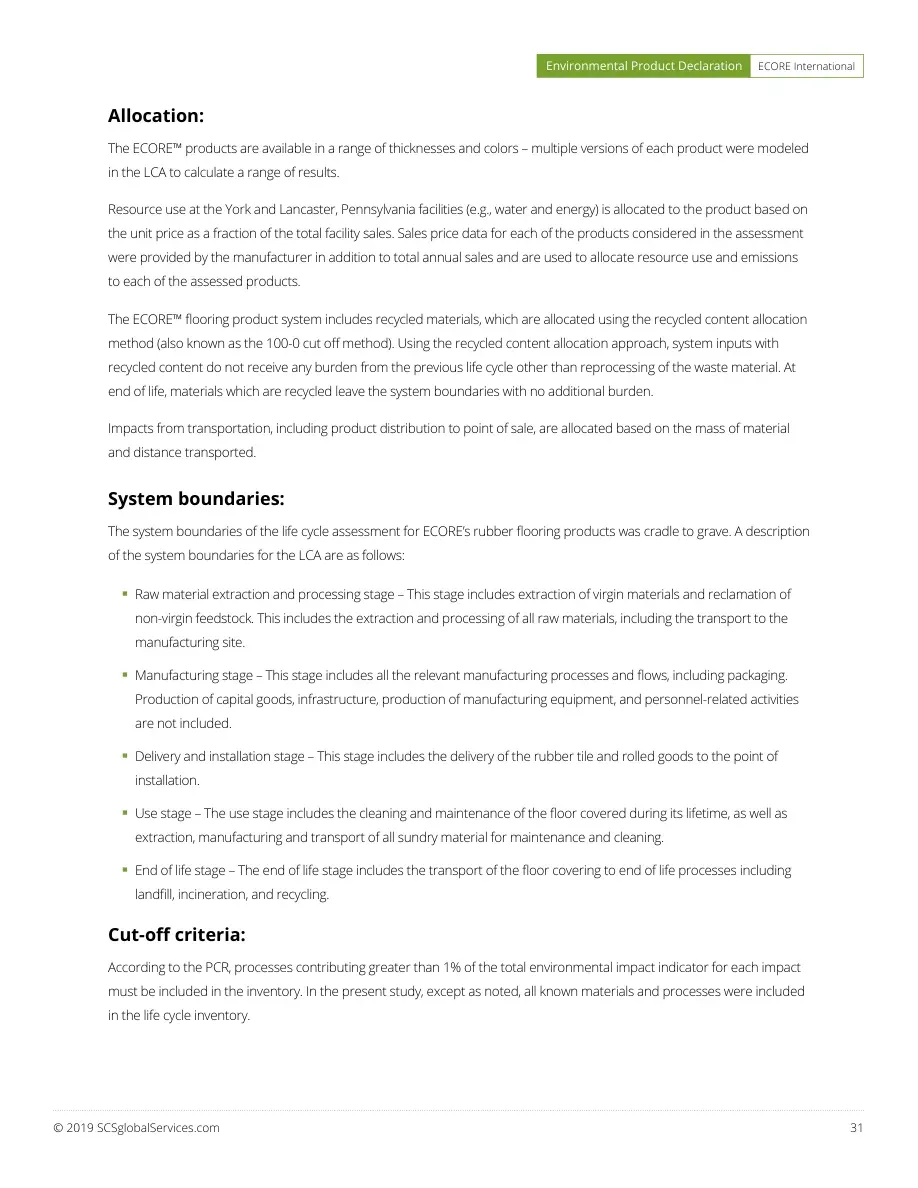
© 2019 SCSglobalServices.com 31 Environmental Product Declaration ECORE InternationalAllocation:The ECORE™ products are available in a range of thicknesses and colors – multiple versions of each product were modeled in the LCA to calculate a range of results. Resource use at the York and Lancaster, Pennsylvania facilities (e.g., water and energy) is allocated to the product based on the unit price as a fraction of the total facility sales. Sales price data for each of the products considered in the assessment were provided by the manufacturer in addition to total annual sales and are used to allocate resource use and emissions to each of the assessed products.The ECORE™ flooring product system includes recycled materials, which are allocated using the recycled content allocation method (also known as the 100-0 cut off method). Using the recycled content allocation approach, system inputs with recycled content do not receive any burden from the previous life cycle other than reprocessing of the waste material. At end of life, materials which are recycled leave the system boundaries with no additional burden. Impacts from transportation, including product distribution to point of sale, are allocated based on the mass of material and distance transported. System boundaries:The system boundaries of the life cycle assessment for ECORE’s rubber flooring products was cradle to grave. A description of the system boundaries for the LCA are as follows:§§ Raw material extraction and processing stage – This stage includes extraction of virgin materials and reclamation of non-virgin feedstock. This includes the extraction and processing of all raw materials, including the transport to the manufacturing site. §§ Manufacturing stage – This stage includes all the relevant manufacturing processes and flows, including packaging. Production of capital goods, infrastructure, production of manufacturing equipment, and personnel-related activities are not included. §§ Delivery and installation stage – This stage includes the delivery of the rubber tile and rolled goods to the point of installation.§§ Use stage – The use stage includes the cleaning and maintenance of the floor covered during its lifetime, as well as extraction, manufacturing and transport of all sundry material for maintenance and cleaning.§§ End of life stage – The end of life stage includes the transport of the floor covering to end of life processes including landfill, incineration, and recycling. Cut-off criteria:According to the PCR, processes contributing greater than 1% of the total environmental impact indicator for each impact must be included in the inventory. In the present study, except as noted, all known materials and processes were included in the life cycle inventory.
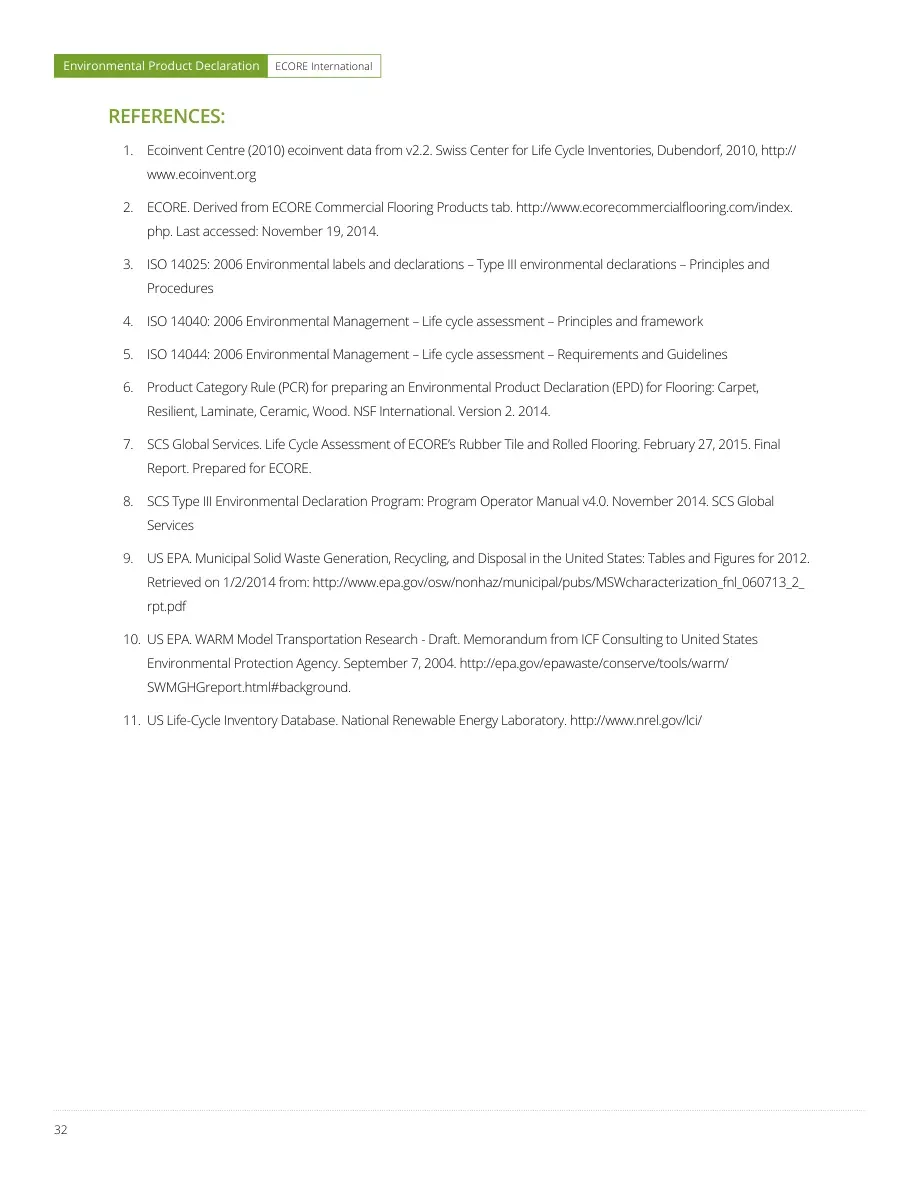
32 Environmental Product Declaration ECORE InternationalREFERENCES:1. Ecoinvent Centre (2010) ecoinvent data from v2.2. Swiss Center for Life Cycle Inventories, Dubendorf, 2010, http://www.ecoinvent.org2. ECORE. Derived from ECORE Commercial Flooring Products tab. http://www.ecorecommercialflooring.com/index.php. Last accessed: November 19, 2014.3. ISO 14025: 2006 Environmental labels and declarations – Type III environmental declarations – Principles and Procedures4. ISO 14040: 2006 Environmental Management – Life cycle assessment – Principles and framework5. ISO 14044: 2006 Environmental Management – Life cycle assessment – Requirements and Guidelines6. Product Category Rule (PCR) for preparing an Environmental Product Declaration (EPD) for Flooring: Carpet, Resilient, Laminate, Ceramic, Wood. NSF International. Version 2. 2014.7. SCS Global Services. Life Cycle Assessment of ECORE’s Rubber Tile and Rolled Flooring. February 27, 2015. Final Report. Prepared for ECORE. 8. SCS Type III Environmental Declaration Program: Program Operator Manual v4.0. November 2014. SCS Global Services9. US EPA. Municipal Solid Waste Generation, Recycling, and Disposal in the United States: Tables and Figures for 2012. Retrieved on 1/2/2014 from: http://www.epa.gov/osw/nonhaz/municipal/pubs/MSWcharacterization_fnl_060713_2_rpt.pdf10. US EPA. WARM Model Transportation Research - Draft. Memorandum from ICF Consulting to United States Environmental Protection Agency. September 7, 2004. http://epa.gov/epawaste/conserve/tools/warm/SWMGHGreport.html#background. 11. US Life-Cycle Inventory Database. National Renewable Energy Laboratory. http://www.nrel.gov/lci/
©2019 SCS Global ServicesFor more information contactSCS Global Services2000 Powell Street, Ste. 600Emeryville, CA 94608 USAmain +1.510.452.8000 | fax +1.510.452.8001For more information contact:ECORE International715 Fountain AvenueLancaster, PA 17601main +717.295.3400 | fax +800.322.1923 | www.ecoreintl.com
